

In the last of his round-ups concerning the contractor profiles he’s written for CFJ over the years, ADAM BERNSTEIN focuses on skills and training
THEY say money makes the world go around. While that may be true, it’s probably more accurate to comment that without the right people with the right skills, businesses wouldn’t be in a position to earn the money to make their world go around.
So, with this in mind, what have these pages learned from contractors about their views on staff, skills and training?
It’s all about standards
Let’s begin with Shane Moore, owner of Dover-based SM Flooring Solutions, someone who is now eight years into running his own business.
Back in 2020 Moore explained how he wasn’t handed his business on a plate. Instead, he had to work his way up from the bottom to create something he’s proud of.
Moore recognised that no business could survive unless it’s different from the competition. As he said then, ‘I thought ‘what can I do to stand out from the other guys, get customers to feel confident in me to do their project?’’ The natural solution was training so that he could ‘work above and beyond what’s needed’.
Consequently, he contacted the NICF for advice, discounted training and discounted tools. ‘I went on a few courses at FITA and gained my master fitter status – it’s what I had been wanting to get for a while to make me stand out from the others in my area.’
He holds master fitter status with the NICF in several fields, and is a Quick-Step master installer, Balterio master installer, and a Luvanto approved installer.
He added: ‘I’m always looking to add to the list… proud to show off that I’ve been trained, been assessed while knowing that others haven’t and also knowing that I can work to British Standards.’
And as he’s keen to emphasise, it’s about doing the best job possible for his clients and knowing what’s needed to install correctly.
It’s worth noting Moore was then, and still is, a British Standard Committee member.
Piecing together a business
Standards are important to a business, but so are staff with skills – especially to a niche business such as the Mosaic Restoration Company run by
Gary Bricknell.
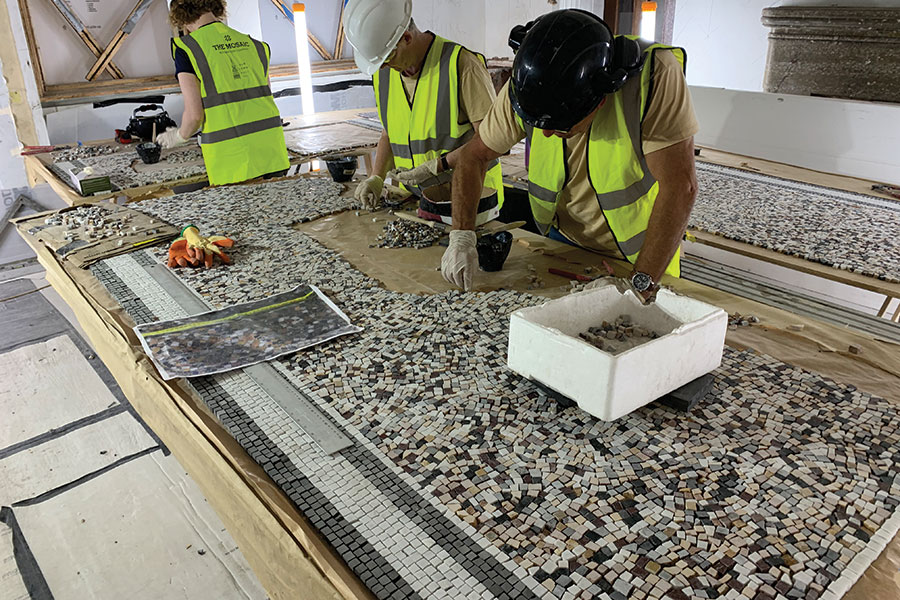
Given that his company specialises in mosaic design, manufacturing and restoration in a multitude of locations from privately held Victorian or Edwardian properties to the restoration of serious pieces of mosaic artwork in public buildings, Bricknell needs people who know what they’re doing.
At the time, he had six people on the books who, in 2023, had been with him for some time – ‘the longest serving has been with me four, eight, twelve and fourteen years’.
In essence, he says that ‘what we tend to do is hire either mosaic artists, conservators or people from similar trades who are skilled in stained glass windows, stone masonry, or are letter carvers and so on’.
Not surprisingly when hiring Bricknell has to sort the wheat from the chaff because, as he says, ‘we get lots of enquiries from people who think that making mosaics would be a nice thing to do. But there’s a misconception about sitting in a workshop and making or creating arty things. Sometimes it’s like that, but many times you’re on your hands and knees on a building site with a hammer and chisel and it’s quite labour intensive’.
The struggle for Bricknell is to find someone that has an artistic flair, is good with their eyes, and understands how to fabricate and design.
Training apprentices is part of the business and every year Bricknell participates in the Prince’s Foundation and takes an apprentice on via the organisation.
Bricknell says the aim is that at any one time he has one apprentice or more training with the company. He says they don’t necessarily stay after training but still thinks it good to pass his knowledge on. ‘What tends to happen,’ he says, ‘is that they go and do their own thing… mosaics or tiling – an allied trade to ours. But what’s useful from my point of view is that with most of them I can pick up the phone to see if they fancy joining us for six months to help with a big job.’
The trade needs to watch out
Steve Whitburn, owner of Torbay-based Steve Whitburn Flooring, noted – when we spoke four years ago – that there are distinct views within the trade on training. And he says that ‘one of the things I find sad about the trade is a rift that seems to exist – which is quite toxic and abusive on some social media forums – between fitters that have gone down the training and accreditation route, and fitters that don’t see the point as they’re already earning a living and so see no need to change or try something new’.
He repeated what others have said on these pages previously – that ‘there are no required qualifications to do what we do – as long as you can get a carpet to a customer’s house, get it down on the floor, you’ll get paid. As far as I’m aware, apart from Quickstep who issue fitters with an individual ID number to validate a product warranty, there’s no incentive from any of the other manufacturers to promote or uphold any kind of industry standard for the installation of what they produce’.
Apprenticeships are, from Whitburn’s perspective, ‘a really good way into any trade as a solid understanding of the basics is key to maintaining quality tradesmen’. He feels ‘a mix of on-site and formal training through organisations such as FITA and FloorSkills should be encouraged more.
‘If only I knew then what I know now – joining the NICF and gaining accreditation was the right move as it’s not only helped my business grow but has given me a new direction in my attitude towards what I do’.
1966 – the start of something good
Finally, while 1966 marked the last time that England won the (men’s) world cup, it also was the year that Lincolnshire Flooring was started by Graham Jefferson’s father, a company that soon became a full-on family concern employing several generations.
With an eye on continued growth, Jefferson told CFJ that the company keeps tabs on its future and operates a training programme for apprentices. There were then – in late 2021 – nine apprentices at the company with three being taken on in the preceding three months.
Jefferson added that Lincolnshire Flooring had ‘worked successfully with a local company, Floortrain, where we send apprentices for off-the-job training to achieve the necessary NVQs’.
The company – and Jefferson for that matter – is hot on training. It’s interesting that, for him, the lack of it in flooring is a personal bug bear as ‘there is a massive skills shortage in an industry that pays well. The work is hard, but it is very rewarding and for us there is plenty of it’.
But as well as apprenticeships, the company offers all staff the opportunity of factory visits and or additional training where needed ‘as we feel this only goes to enhance knowledge.’
Looking to the future, the company has managed to recruit new people into all sectors of the business ‘that,’ Graham says, ‘should take the company on for the next 20 years or so’.
Wrap up
Living in splendid isolation, not wanting to learn anything new, will carry a contractor only so far. But with the updated skills and an open mind on learning, the future looks bright for those willing to change.
Adam Bernstein is an independent columnist