
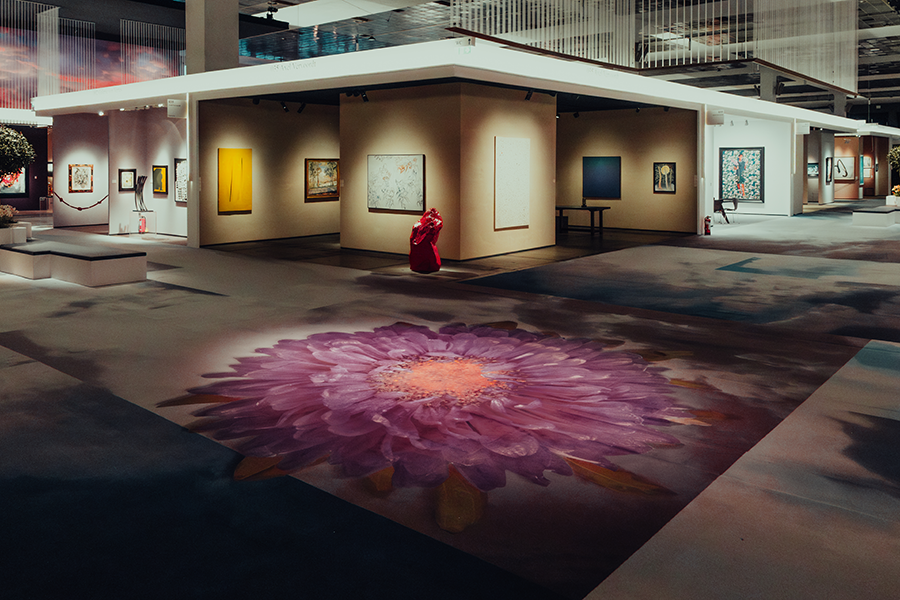

For Ege carpets, design has always come first. According to Chris Richardson-King, technical manager at Ege UK, that philosophy sits at the heart of everything the Danish manufacturer does.
‘We are, and always will be, a design-led business,’ says Chris. ‘Everything that surrounds us is special and different to other manufacturers. We are very much a Scandinavian design house where our strength is our ability to take a client’s concept and translate it directly into the fabric of the carpet.’
Founded in 1938 and headquartered in Herning, Denmark, Ege Carpets has grown into a global business with five specialist manufacturing facilities, each dedicated to different product types or elements of the production process. Despite that growth, Chris says the company has never lost sight of its origins.
‘We’ve always been about carpets and design,’ he explains. ‘It’s about relaying the desires of the customer into the carpet itself. The switch to the Millitron process completely revolutionised that for us.’
That process is central to what makes Ege stand out. The company has been using Millitron technology for around 50 years, a system that allows Ege to digitally dye the tufts of the carpet.
‘We’re one of only a handful of companies in the world that can take a photograph and turn it into a commercial-grade carpet,’ Chris says. ‘The Millitron machine has 42,000 dye jets working across four colour palettes, using 12 base colours and 65 accent colours. That means we can introduce shading rather than stark colour changes, giving us the ability to translate something as complex as a photo into carpet.’
Unlike traditional printed carpets, Ege’s digitally dyed products achieve Class 33 performance, making them suitable for demanding commercial environments such as hospitality and offices.
‘If you imagine a photograph, every pixel is a different colour or shade,’ Chris explains. ‘Trying to recreate that with different coloured yarns is fraught with problems. The Millitron removes that limitation entirely.’
In fact, Ege is the world’s largest manufacturer of white carpets, which are then bespoke dyed to meet individual customer requirements. But while the technology is impressive, Chris is keen to stress it’s always driven by intent rather than novelty.
‘What’s amazing isn’t just the technology itself,’ he says. ‘It’s that we combine it with a very strong sustainability ethos and clear design intent.’
Sustainability is embedded throughout Ege’s product portfolio. The majority of its products are manufactured using regenerated yarns, including ECONYL regenerated polyamide made from recycled fishing nets and other waste materials. Where wool is specified, Ege uses specific wools sourced from both UK and New Zealand herds, a renewable and recyclable material that can also be combined with regenerated fibres if desired.
‘Even the backing systems are sustainable,’ Chris explains. ‘The yarn face is made from regenerated or recyclable materials, the backing is made from recycled plastic bottles and suchlike, and some products are even bonded using PVB laminate – the same material used in car windscreens. The broken glass can be separated from the film and repurposed in a liquid form.’
That commitment has earned Ege some of the industry’s highest sustainability credentials.
‘All of our products are Cradle to Cradle,’ says Chris. ‘We have also achieved EcoVadis Platinum, which is incredibly tough to attain. Only a small number of companies get there which puts us in the top 1%. Everything we make is either regenerated or can be regenerated in the future.’
However, Chris is candid about the challenges that come with delivering circularity in the UK market.
‘Since Brexit, integration with Europe has become more difficult,’ he says. ‘A lot of regeneration doesn’t happen in the UK – it happens in Europe – and that can increase the carbon footprint. The real question is where the cost sits. Is it with the manufacturer, the contractor or the end-user?’
To help address this, Ege work closely with partners such as UPLYFTED, who manage the reuse of carpet tiles and clean waste material from installation.
‘We’re seeing a real upturn in the use of second-hand carpet tiles,’ Chris reveals. ‘Tiles are taken back, cleaned, tested and reused. In some cases, a reused product is actually more valuable than a brand-new one due to having dispensed it’s negative manufacturing impact through it’s first use.’
That thinking has led to the launch of a pilot project in Scandinavia called Ege REUSE, a scheme offering carpet tiles that have been reclaimed, cleaned, tested and certified to meet all relevant industry standards.
‘I didn’t think REUSE would be commercially viable at first,’ Chris admits. ‘But it makes complete sense. There’s demand from housing sector, people struggling with cost pressures, and also a massive demand from commercial clients who want to meet sustainability targets.’
As a core member of the UK Sustainable Flooring Association (UKSFA), Ege plays an active role in shaping the future of the industry.
‘It’s vital to be involved early,’ says Chris. ‘The UKSFA gives manufacturers a voice in matters before the become legislation. We work with a cross-section of other manufacturers to support end-of-life solutions and keep ahead of current and future regulation.’
In terms of markets, Ege sits deliberately outside the mainstream.
‘We don’t operate in the domestic sector at all,’ Chris explains. ‘Everything we do is made to order. We work primarily with architects and designers, and secondarily with flooring contractors once our products are specified.’
Its largest sector is offices, followed closely by hospitality, with major agreements in place with global hotel brands and office developers. The company is also particularly strong in marine, supplying cruise ships and related projects.
Post-Covid, Chris says the business proved resilient.
‘Offices didn’t disappear,’ he says. ‘‘In an era of WFH and hybrid working, the office spaces now need to earn the commute, so whilst the market slowed a little across all sectors, what we saw was a shift – satellite offices, changes in layout – but they still needed flooring. The cruise industry slowed dramatically, but now it’s bounced back massively. New ships are being commissioned all the time, and some of the older fleet being modernised.’
Some high-profile projects include installations at Tate Modern, Virgin Media O2, the Westin Hotel (a Marriott property), and Sky Lounge meeting rooms delivered with Loughton Contracts.
‘What we offer is quite special,’ Chris says. ‘You come to us with a concept. We design it, manufacture it and ship it – all in-house. Once an order is placed, we can typically deliver to a UK address within four to five weeks.’
Despite Ege’s bespoke capabilities, Chris is realistic about managing expectations.
‘We can do truly bespoke work,’ he says. ‘But there is always an element of interpretation through design and through manufacture that needs to be factored in. That’s why setting expectations early is critical. Our standards are high, and so is our customer focus.’
Trend-wise, Ege tends to stay ahead of the curve rather than follow it.
‘By the time something hits the UK, we’ve already moved on,’ Chris says. ‘The UK generally follows Europe. Right now, we’re seeing a strong move towards bold colours and patterns – marbling themes – think purples, turquoises, blues. Multicoloured marbling is very prominent.’
Those trends are showcased at Ege’s Clerkenwell showroom and across its social media channels, with LinkedIn acting as a key platform for case studies, factory videos and design inspiration.
Chris himself brings more than 25 years of flooring experience to the role. ‘I fell into the industry on the retail side as an assistant manager,’ he recalls. ‘I worked my way up, and then got on the tools and absolutely loved it. The job satisfaction as a fitter is unrivalled.’
After completing a range of industry qualifications, Chris moved into technical management, spending 5 years with Uzin before joining Ege in early 2024.
‘I’ve been a technical manager for seven years now,’ he says. ‘What attracted me to Ege is that what we do genuinely push boundaries. We’re not just selling a product – we elevate your space.’