
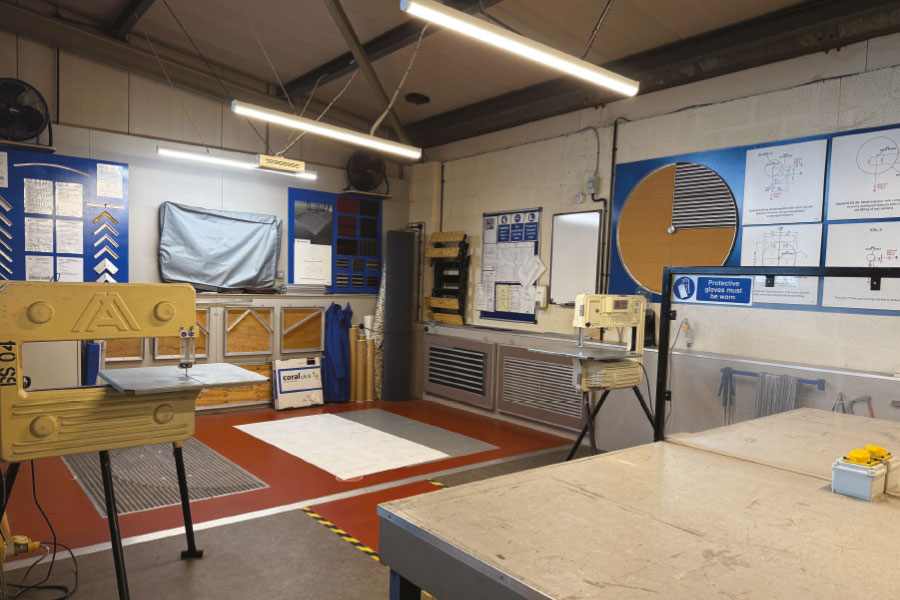

After recently celebrating 100 years of its Nuway entrance matting in 2024, CFJ was invited to Forbo Flooring Systems’ factory in Telford to learn about the history of this unique product
ON arrival CFJ was introduced to Jason Holmes, head of design – textiles, and Simon Austin, operations manager, at the Telford premises before being presented with the history of Forbo’s entrance matting – Nuway.
Nuway: the history and heritage
In the ‘20s Birmingham was recovering
from World War 1, with many families trying to rebuild their lives and homes. Despite this it became known as one of the cities at the heart of this change, becoming the home of many trades and businesses.
Among the entrepreneurs was Joseph Gasking, a medical orderly during the war, who returned to the city with his vision of a small business building motorcycles at Woods garage on Rea Street Brimingham – known as W and G. Over time Joseph began to experiment with the vison of link matting using old tyres and steel wire – inspired by his previous experience in motorcycles. Joining him was George Wilson, who helped develop the concept of creating mats using links punched out of old rubber tyres. By late 1924, Joseph had created a prototype mat which became what we know today as Nuway – initially developed for the residential sector.
In 1925, both Joseph and George were looking to upscale the manufacturing process partnering with William Spicer, a local entrepreneur, and beginning production in Old Grange Road, Sparkhill. This was further expanded in 1927 with a move to bigger premises in Coalport, Shropshire.
By 1926 the first Nuway patent had been granted and in May, the company was officially registered under the name Nuway Manufacturing Co. Limited. It was around then that local businesses started to become aware of what the company were doing, in particular engineer Reginald Vernon Charleswood Brook. It was decided at the first meeting between Jospeh, George, Reginald and William that Spicer would leave the company with his share bought out, Joseph Gaskin then became managing director and Reginald Brook took a seat on the board. A sales office soon followed, at Queens College Chambers on Paradise Street, to maintain a presence in Birmingham.
Shortly after in 1930 Joseph left the company and the Nuway vision was expanded to cover a range of innovative and diverse applications such as golf tee mats, cricket mats, surrounds of swimming pools and ice rinks to name a few. There were even applications for the transport industry, such as link mats for ships, horse boxes, pick-up vehicles and car interiors. To complement the company’s diverse vision, many adverts were developed and placed in publications to showcase its extensive portfolio.
During World War 2 the company paused production, with the machinery equipment put up for sale in 1942, however nothing ever came of it and in 1945 the business was back in action. From here the product became available in various sizes and colours, implemented through PVC spacers.
Following decades of steady development, Tuftiguard was developed in 1964, being marketed towards the commercial sector, cementing its future in entrance matting, still being used for many applications such as airports, supermarkets and hospitals to this day.
After the death of Reginald Brook in 1969, his son John Brook took over the company, marking the beginning of new developments including the coir matting systems – which were added to the matting range in the company’s portfolio. In addition to this, manufacturing under a license began, creating a patented staircase system. This required more space so the lease of a unit in Halesfield was signed, where aluminium matwell frames were also manufactured. The staircase side of the business saw fast growth leading to its sale in 1977. It’s said at the time the sale took place, 600 bespoke staircases had been manufactured.
The 1970s saw an issue with the supply of suitable used tyres, so the development of nylon-reinforced rubber sheets began in-house. This of course, led to the need for more space and so another lease was secured at B5 and B6 at Halesfield 24.
In 1979, the business was acquired by the Thomas Tiling group of companies and in 1982, a new factory was established in units G1 and G2 in Halesfield to complement the existing factory at Coalport, which remained the main office and manufacturing site. This Halesfield site is still home to Nuway production to this day.
John Brook resigned from the business in 1981, ending 55 years of the Brook family being a part of Nuway. Following this, in 1983, the Thomas Tiling group of companies were taken over by the BTR Group and by the 1980’s Nuway was employing 188 people and being exported to 35 different countries across the globe. All manufacturing moved to the Halesfield location by 1991, after the Coalport site was sold and in 1997, Bonar Floors, which had also recently bought Royal Tufton, another producer of entrance matting, acquired Nuway. The portfolio grew quickly under Bonar Floors and in 2008, Forbo Flooring Systems acquired the company. Textile flooring and entrance matting had now officially been added to Forbo’s already established portfolio of vinyl and linoleum floorcoverings.
Girl power
Women have always been at the heart of Nuway. After the breakout of World War 1, when Nuway had its beginnings, many men were called up for military service, leaving women to fill in the roles of those who had left.
By World War 2, the view of women in the workplace had changed drastically and it was more commonplace. As such, by the time of Nuway’s reopening in 1945, the business had become a very attractive workplace for women, owing to the administrative and manufacturing skills developed over the course of the last few decades. In fact, so much so was the impact of women on the company, that Nuway appointed its first female director, Mrs AE Boulton following
World War 2, succeeded by Mrs RMB Smith in 1951.
Jason Holmes, head of design – textiles at Forbo Flooring Systems, spoke about the role women had to play in Nuway’s development, saying: ‘To this day, many women still work at Nuway, with the intricate work, attention to detail and patience that’s needed to manufacture the product lending itself perfectly. Many women at the company have spent much of their careers at the Telford factory, further adding to the craftmanship and authenticity of Forbo’s products, one of the many elements of Nuway that Forbo is proud of.’
Nuway today
After being taught about Nuway’s history, Simon Austin, production manager for the Telford site, showed CFJ the main products that make up its collection – as well as taking a tour around the factory and seeing Nuway being created.
Forbo currently offers three ranges in its entrance matting systems portfolio: Nuway Tuftiguard, Nuway Grid and Nuway Connect – each one is bespoke and made to order.
Regarding Tuftiguard, the flagship, double-sided product of the Nuway range, you can mix and match its design, scraper bars and colour, to fit both aesthetic and functional needs. You also have the options of manufacturing them with open construction or closed construction. Open construction mats are ideal for entrances that are susceptible to increased moisture whereas closed construction mats are made for internal applications and are the most common construction for Nuway entrance mats.
Nuway Grid by Forbo Flooring Systems is a suitable solution for heavy traffic entrance areas for internal and external use. Aesthetics play an important part in the space which is why elements such as Coral carrier sections can allow colour co-ordinated areas to be created with primary and secondary entrance matting products. The colour strips for the inserts are available in 11 different colourways for internal use, selecting from the Coral Classic, Coral Burford and Coral Brush ranges. Being a single side matting option, it is most suited for use in office, retail, healthcare and education entrances to name a few.
Nuway Connect is a versatile roll up single sided mat, available with a choice of five Coral Classic inserts. Where increased dirt and moisture retention is required, there are options such as Ultragrip and Bristle inserts available to provide extra support. Another benefit for the Connect range is its flexibility to shape easily on-site, making it a suitable choice for unusual and awkward sized entrances.
How Nuway is made
Nuway entrance matting reflects a philosophy – one built on heritage machinery, skilled hands and continuous adaptation.
Simon spoke about the production process of Nuway, saying: ‘One feature of the Telford site is the continued use of legacy machinery, much of the equipment used to manufacture Nuway has been in service for decades. Some machines even date back to the early 1980s, while others incorporate components originally designed for entirely different industries, including leather processing. Rather than being discarded, these machines have been repurposed, rebuilt and refined, often multiple times, to meet evolving production needs. This approach has created a manufacturing environment where old and new engineering coexist.
‘Rubber sheets, around 9.5m long are crane-loaded and fed through a multi-disc cutting machine frequently described as resembling a ‘pizza slicer’. The rotating discs cut cleanly through the rubber, producing consistent strips ready for assembly.’
Elsewhere on the line, former leather-slicing equipment has been adapted to slice rubber and tyre cord layers. Some components are believed to be close to a century old, forming part of machines that have evolved alongside the Nuway product itself.
Simon continued: ‘Nuway’s performance begins with the rubber. Each sheet contains multiple layers of tyre cord, embedded within the rubber during manufacture. This cord plays a vital role in how the mat manages moisture.
‘During processing, the rubber surface is buffed to expose the tyre cord. This creates a capillary effect, allowing moisture to be drawn down through the mat and into the matwell beneath, away from foot traffic. Rather than relying on surface texture alone, moisture control is engineered into the material structure. Colour stability is achieved by dying the tyre cord rather than the rubber, improving long-term appearance and reducing variation over time.’
Despite the industrial nature of the materials, much of Nuway’s quality depends on manual assembly and judgement. Holes are pierced or drilled into rubber and bamboo profiles with extreme accuracy, allowing steel wires to pass through and bind the system together.
Simon added: ‘Rubber profiles can be stamped or pierced, while bamboo, being a natural material must be drilled to avoid splitting. During assembly, wires are threaded, tensioned, bent and finished by hand to ensure the mat remains flat and dimensionally stable. Careful sequencing prevents twist and misalignment as the mat is built up profile by profile. This combination of machine precision and human control is central to Nuway’s consistency and durability.’
Nuway mats typically begin life as rectangular sections before being shaped to fit specific entrances. Using bandsaws, technicians cut mats to match drawings or physical templates, producing complex forms such as curves, angles and revolving-door layouts.
Simon said of this: ‘Because real buildings are rarely perfect, templates are often required as well as dimensions. Revolving doors, for example, tend to actually be circular, and Nuway’s shaping process accounts for these tolerances. After cutting, steel wires are reworked and re-secured to maintain structural integrity.
‘Finished sections are then labelled and supplied with drawings, allowing installers to assemble them on-site in a sequence, similar to flat-pack furniture.’
Waste handling reflects the same philosophy seen throughout production. Aluminium and steel offcuts are recycled, while rubber waste is repurposed for agricultural and equestrian applications, such as walkways and riding arenas.
Speaking on this, Simon said: ‘Very little material leaves the site without a second life. Nuway’s manufacturing heritage is actively used as a competitive advantage, allowing Forbo to produce bespoke, engineered entrance matting with a level of control and adaptability that mass production struggles to match.
‘At Telford, heritage machinery, skilled operators and modern process thinking come together to produce a refined system.’
How Nuway Tuftiguard is made
How Tuftiguard is made step-by-step:
- Rubber sheet is made on-site. Rubber is prepared using Forbo’s machinery. Thin layers of rubber are stacked and placed into a curing oven where heat and pressure bond the material into a single structure.
- It’s then moved into the strip cutting process. The rubber sheets are cut into precise widths creating rubber strips before then being cut to bespoke lengths, specific to each order.
- Each rubber strip undergoes surface preparation before assembly. The surface of the rubber is buffed to control friction, ensure consistency across the mat and improve long-term performance. Exposure of the tyre cord allows the moisture to pass through the mat. The rubber sections are the cleaning, moisture wicking part of the mat.
- Strips are then punched with a repeating hole pattern to allow construction of the mat. This process is one of the many cleverly engineered geometry elements for the development of Nuway Tuftiguard. The rubber may also be cropped again at this stage to ensure precise measurements.
- Aluminium profiles are then used to form the structural spine of the product.
- To add to the durability, steel wire is used to weave and bind the system together. To begin with, the wire is cut and bent before it’s utilised to assemble the product together.
- For Nuway Grid and Connect mats, a textile insert is used. The inserts for the mats are produced from high-performance polyamide (nylon) yarn. This material is tufted to create a dense material. The fibres are heat-set, to ensure recovery under compression. These textile elements are designed to absorb moisture efficiently while releasing dirt during cleaning, maintaining appearance and performance over time. The textile inserts for the products are mechanically locked into the rubber strips, creating a secure mechanical connection.
- Assembly is the process where Tuftiguard becomes a whole product. To withstand weight and footfall, the product includes steel wires. They run through the mat, allowing them to absorb heavy traffic and movement while keeping the product stable.
- Rubber and aluminium strips are laid side by side. Steel wires are threaded through the perforations and aluminium wire is used to bind the product together. This creates a rigid yet flexible structure, allowing Tuftiguard to maintain performance over many years.
- The product is then sent to be shaped depending on the order and the specifications required. These dimensions are often sent by the customer and are cut to the specific measurements for the space it’s to be laid in.
- Depending on the project, some require a logo to be embedded in the bespoke mat. This is another element of Tuftiguard where craftmanship and precision takes place.
- Every mat is subject to a manual inspection before dispatch back to the client. Dimensional accuracy is checked, alignment and finish are visually inspected, products are often photographed for quality records.
Many Tuftiguard systems are double-sided, allowing them to be lifted, reversed after years of use, extending the life of the product and minimising replacement costs.
How Nuway is installed
Once the product has been made, it can be installed by a Forbo Entrance System Specialist Installer (FESSI) contractor. As Nuway is such a specialist product, it requires proper training to install, hence why Forbo runs its own training courses that teaches contractors how to fit industrial entrance matting.
After being showed around the factory, Simon introduced CFJ to Jeremy Brazier, training manager at the Nuway premises, Telford. He explained how Forbo Flooring Systems have developed a training programme in partnership with the Construction Industry Training Board (CITB), helping fitters understand how to fit industrial entrance matting – as part of the SCS card which is now required in the industry.
Forbo Flooring Systems operates a dedicated four-day Nuway installer training programme, designed to equip contractors with the practical skills, technical understanding and site awareness required to install rigid entrance matting correctly and consistently. The course showcases the realities of live site conditions and places strong emphasis on craftsmanship, planning and problem-solving.
The Nuway training programme is hands-on, with approximately 75-80% of the course dedicated to practical work. While classroom-based theory forms an important foundation, the focus is on developing competence through doing.
Jeremy spoke on the course, saying: ‘Training begins with the fundamentals: reducing or expanding mats, straight cuts and finishing into rubber or aluminium edges. From there, participants progress to angled cuts, followed by more demanding tasks such as curves, circles and circular columns. Later stages of the course introduce complex layouts, including chevron patterns, triangular sections and curved entrances, encouraging installers to break down challenging designs into manageable components. A recurring theme throughout is reducing waste while maintaining dimensional accuracy and alignment.
‘A defining feature of the course is its emphasis on real site scenarios. Trainees are presented with common challenges encountered on live projects, including: changes to layouts after surveys have been completed, fixed obstacles such as posts, security barriers and street furniture, misalignment between drawings and site conditions and entrances being used as storage or dumping areas by other trades. Installers are taught how to plan for these situations, including how to split mats, rewire sections, and maintain tension and stability after cutting.’
The course also focuses heavily on tool selection and technique. While jigsaws are commonly used on-site, trainees learn why certain tools are better suited to specific tasks, particularly when cutting galvanised steel wires.
Jeremy touched on this, saying: ‘Participants are introduced to bandsaws for precision cutting, alongside best-practice methods for pre-finishing wires, maintaining tension and rejoining mats correctly after adaptation. Beyond cutting and fitting, the programme places strong emphasis on planning and preparation. Topics covered include: templating techniques, understanding recessed and surface-mounted frames, checking subfloor conditions, awareness of moisture, relative humidity and DPM requirements and sequencing work to avoid damage or disruption.’
The four-day course follows a clear structure:
- Day 1: Induction, theory, frames, single-sided mats, straight cuts
- Day 2: Angled cuts and increasing complexity
- Day 3: Curves, circles, advanced tooling and site preparation
- Day 4: Final practical assessment and theory test
Jeremy added: ‘The assessment includes a practical test piece combining multiple skills, alongside a short multiple-choice theory questionnaire. Successful candidates receive a Forbo Nuway certificate, valid for three years, supporting application for a CSCS card (subject to external health and safety requirements).
‘Courses typically run monthly, with a maximum of four candidates per session. This small-group approach allows trainers to provide close supervision and tailored guidance, ensuring standards are maintained. A one-day refresher course is also available for experienced installers, reflecting Forbo’s commitment to long-term competence and quality assurance across the supply chain.’
Find out more about this and how you can register for a space on the course, please contact us.
What’s next – Nuway Connect Plus
Forbo Flooring Systems recently launched its Nuway Connect Plus, an enhanced version of its single-sided modular entrance matting system. The new design features larger textile inserts and reduced aluminium strip widths, increasing design flexibility and enabling more varied layouts, including chevron patterns and bespoke configurations.
Available with a choice of four Coral Classic textile inserts, or Ultra-Grip rubber Nuway Connect Plus allows the primary entrance system to be colour-coordinated with secondary matting zones. All inserts are replaceable on-site, supporting extended wear life and simplified maintenance.
Nuway Connect Plus is available in either a 10mm or 17mm closed construction, and for entrances in fire-sensitive locations can be specified with Coral inserts achieving Bfl-s1 fire performance.
Donna Hannaway, head of marketing UK and Ireland from Forbo Flooring Systems, spoke on the new range, saying: ‘We’re committed to providing our customers with a wide variety of high-quality entrance flooring systems that continually meet varying requirements, current market trends and budget levels.
With its enhanced features, Nuway Connect Plus represents Forbo’s renewed focus, drawing on its heritage to drive its entrance matting portfolio forward.’
www.forbo-flooring.co.uk/nuway