

FLOOR FINISHES, SEALANTS & VARNISHES
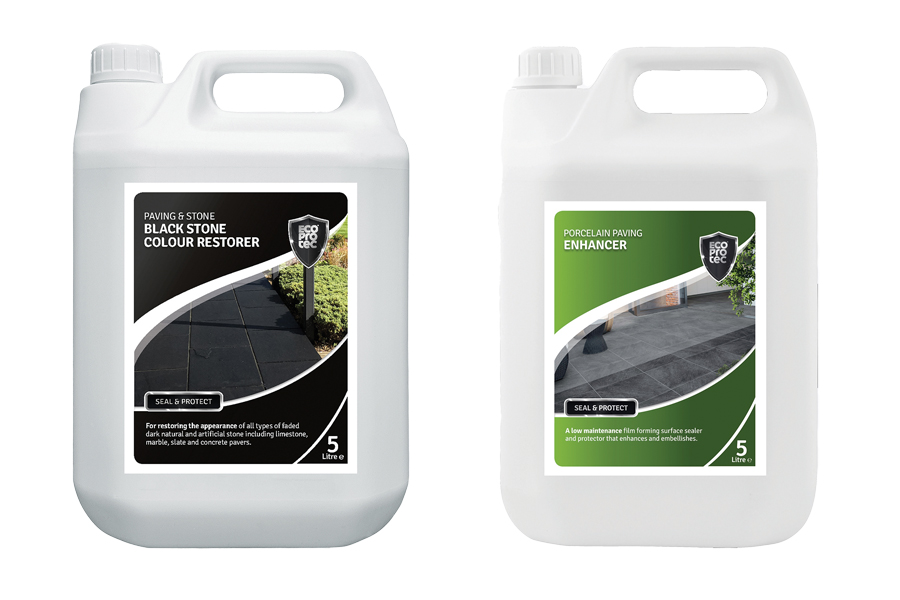
Developed to restore and protect faded outdoor pavers, Black Stone Colour Restorer joins ECOPROTEC’s Porcelain Paving Enhancer, which also reportedly features a formulation that’s free from forever chemicals.
Developed for limestone, marble, slate, concrete and artificial stone surfaces, Black Stone Colour Restorer is a water-based treatment that is said to contain a permanent colour intensifying pigment.
Says the company: ‘It’s applied in multiple coats until the desired colour effect is achieved – from dark grey to ebony – to restore appearance to pavers faded by UV rays, humidity and rainwater, and to protect them from the elements going forward.
‘To maintain a very dark, pristine finish, annual treatment with Black Stone Colour Restorer is recommended, although a treated stone will maintain a far darker aesthetic than an untreated stone for between four-to-five years.
‘Launched last spring – and also a water-based treatment – ECOPROTEC Porcelain Paving Enhancer is a self-shine solution that gives tiles a ‘just washed look’. It also provides practical benefits, being highly resistant to foot traffic, general wear and stains, and promotes easier maintenance.’
Continues the company: ‘Like Black Stone Colour Restorer, the treatment is UV-resistant and, whilst glossy in nature, causes minimal change to a tile’s slip resistance properties.
‘ECOPROTEC floor finishes are manufactured in the UK and are offered alongside a comprehensive range of maintenance products developed for the contractor and landscaper. ECOPROTEC is currently working towards a complete range of PFAS-free sealers that contain no perfluoroalkyl/polyfluoroalkyl substances, with reformulations scheduled for introduction in late 2026.’
www.ecoprotec.co.uk