IN an era where sustainability is reshaping every corner of the construction sector, Junckers, one of Europe’s most established names in solid hardwood flooring, has found itself playing a new and unexpected role, that of educator.
‘What we’ve learned from the recent Department for Education tender,’ says David Papworth, UK general manager for Junckers, ‘is that we’ve ended up advising main contractors on how best to comply with new legislation on sustainability. We’ve come to understand that, yes, we supply a product, but for our clients, contractors, and specifiers, the most value we provide is education. It’s not just ‘look at our product’, it’s ‘how can we help your business meet these new standards?’’
This marks a subtle but important shift for the Danish manufacturer. Founded in 1930 by Flemming Juncker, a visionary Danish Master of Forestry, Junckers began as a small sawmill in Køge, Denmark. Flemming’s innovative approach to forestry management, emphasising sustainable practices and the efficient use of timber was ahead of its time. He believed in utilising every part of the tree, reducing waste and ensuring the longevity of forest resources.
This philosophy laid the foundation for Junckers’ commitment to sustainability, a principle that remains central to the company’s operations today. By the ‘60s, Junckers had expanded its reach beyond Denmark, establishing a presence in the UK in 1961.
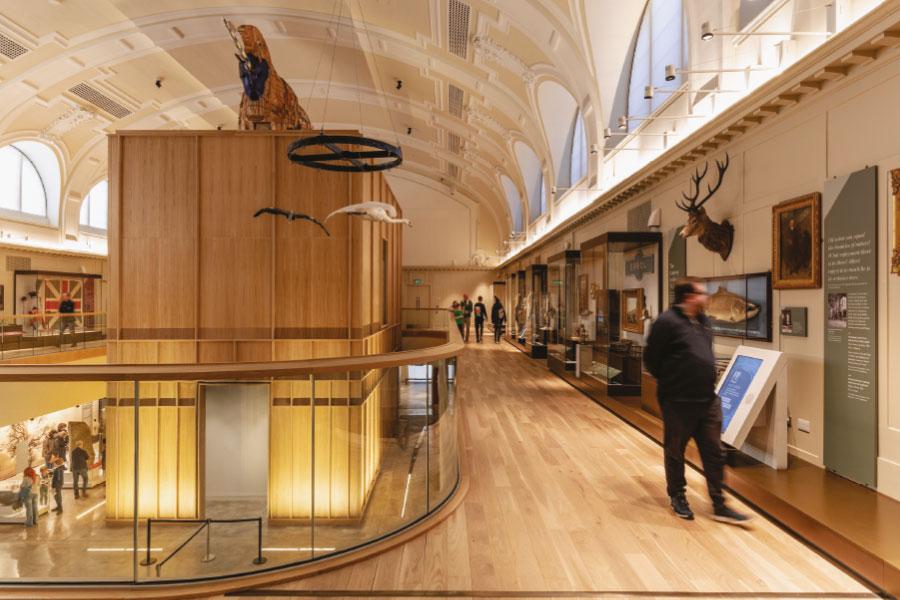
Over the decades, the company has grown to become Europe’s leading manufacturer of solid hardwood floors, employing over 1,200 people worldwide. Junckers’ products are now synonymous with quality and durability, found in a diverse range of public spaces across the UK, from museums and art galleries to city halls and performance venues. These environments value the longevity, quality, and authenticity that Junckers’ floors offer, reflecting the company’s enduring legacy and commitment to excellence.
‘Customers value the longevity of a solid hardwood floor,’ David continues. ‘In years gone by, there were more options in the market than there are now, but today we operate firmly in the premium space. Clients who invest in our floors aren’t just buying a surface; they’re buying a material that performs beautifully for decades, and that matters more than ever in today’s climate.’
Timber as the hero material
Junckers’ renewed relevance lies in the fact timber is now recognised as a hero material for sustainable construction. As governments and institutions push for lower-carbon building solutions, solid hardwood has re-emerged as an essential part of the conversation.
David points to the Department for Education’s (DfE) latest school construction framework as a clear example. ‘We’ve seen clients within government ministries increasing their sustainability requirements,’ he says. ‘The DfE has introduced three key measures: a 60-year design life for new schools; a requirement to measure the biogenic content of each building – that is, the carbon sequestered in natural materials like wood; and a maximum embodied carbon threshold of 550kg of CO2 equivalent per sq m.’
These measures, he explains, will shape the construction of 200 new schools over the next five years. ‘Timber plays a vital role here because it’s one of the few building materials that actually removes carbon from the atmosphere and locks it away. Once it’s used in a product like flooring, that carbon stays stored for the lifetime of the building.’
This shift reflects a broader industry awareness that long-term durability directly affects a building’s carbon footprint. ‘We now know that 40% of a building’s lifetime carbon emissions come from replacing finishes or services over its 60-year design life,’ says David. ‘That means the more durable your finishes are, the lower the overall carbon footprint. There’s now a real focus on ensuring the 60-year design life applies not just to the structure, but to the finishes as well and that’s exactly where Junckers fits in.’
Reuse, repurpose, remanufacture
Junckers’ sustainability leadership isn’t just theoretical – it’s tangible. The company has launched a reuse and repurposing scheme for its solid hardwood floors, allowing them to be lifted, restored, and reinstalled elsewhere.
‘One of the best examples,’ says David, ‘is the Caledonia Gladiators, who play in Britain’s top basketball league. They’re currently using a floor that was originally installed ten years ago at Birmingham University. The floor was lifted, transported to East Kilbride in Glasgow, and reinstalled – it’s now performing at elite level again.’
This circular approach is gaining traction among contractors too. ‘We’re being asked to help them reuse flooring on an industrial scale,’ he continues. ‘We’re now taking floors back from residential apartment blocks, running them through our factory to sand the surfaces and remanufacture the tongue and groove joints, applying a new factory finish, and then delivering floors that could easily be 25 years old to be installed in new buildings.’
It’s a striking example of how established craftsmanship meets modern sustainability expectations. ‘This process closes the loop,’ says David. ‘Instead of waste, you get renewed value and it’s something we’re very proud to lead on.’
Meeting the needs of public and heritage buildings
Beyond newbuilds, heritage and public buildings remain a stronghold for Junckers. ‘In public buildings (museums, art galleries, city halls) there’s a requirement for long lifetime, and our floors have proven the test of time,’ David explains. ‘Probably 90% of flooring in these types of buildings in the UK are oak floors, and that’s part of our history.’
With the UK now facing a backlog of heritage restoration projects, this area of the market is only growing. ‘Alongside Italy, the UK has one of the highest percentages of heritage buildings in Europe,’ he says. ‘We’re seeing a shift away from demolition toward renovation and repurposing and many of these structures already have timber floors. That plays directly to our strengths.’
A heritage product for the future
Junckers continues to evolve its portfolio to meet these changing demands. ‘We’ve recently revamped our range of heritage flooring, particularly our solid hardwood herringbone range,’ says David. ‘It’s available in 480mm lengths in unfinished solid hardwood, ready for site finishing using our own range of coloured oils and two-pack polyurethane lacquers.’
This combination of craftsmanship and flexibility allows architects and contractors to achieve bespoke finishes while maintaining the durability and environmental credentials that define Junckers’ brand.
Education as the new value
If there’s a common thread through Junckers’ evolution, it’s the company’s recognition that its value goes far beyond supplying materials. ‘We’ve realised that education is at the heart of what we do,’ says David. ‘Helping clients, contractors, and specifiers understand how to comply with new sustainability standards, how to calculate embodied carbon, or how to reuse existing materials. That’s where we can make the biggest difference.’
It’s a philosophy that aligns perfectly with the future of construction. ‘The world is jumping on the timber bandwagon,’ David concludes, ‘but we’ve been here for nearly a century. The beauty of solid hardwood flooring isn’t just its look or feel, it’s the fact it lasts, performs, and supports a truly circular, sustainable future.’
07391 010487
dpa@junckers.com
www.junckers.co.uk