

WOOD flooring is an investment that delivers warmth, character and visual appeal to any room. However, preserving its beauty over a lifetime requires more than just careful installation, it also needs an approach that respects wood’s natural characteristics. Flooring contractors need to take a holistic view of wood flooring installations, following the basics of floorcovering installation while bearing in mind a few unique considerations, explains.
Key issues
Wood is naturally hygroscopic, meaning it readily absorbs and releases moisture. Unmanaged excess subfloor moisture is, therefore, the single greatest threat to a wood floor, leading to aesthetic failures like cupping, warping, or buckling, and ultimately attacking the adhesive bond, causing complete floor failure.
Wood also expands and contracts significantly as a result of changes in atmospheric conditions, including temperature and humidity. This exerts strain on adhesives and the surface to which floor coverings are bonded. Engineered wood, while less prone to this, will still be affected.
First steps
Having ensured the subfloor is suitably sound, smooth and free of any contaminant, including any old adhesive residues, it’s essential to determine if it is dry enough to receive floorcoverings by undertaking a moisture test. F Ball recommends this as a routine procedure as part of any flooring installation. Using a calibrated digital hygrometer, in accordance with British Standards, is the only way to accurately measure subfloor relative humidity levels.
Normally, a waterproof surface membrane will be required to suppress excess subfloor moisture when subfloor RH levels are above 75%. However, the maximum permitted figure is 65% where wood floorcoverings will be installed because of the wood’s sensitivity to moisture.
Waterproof surface membranes create a barrier between floorcoverings and subfloor, protecting the floorcovering from the adverse effects of excess subfloor moisture.
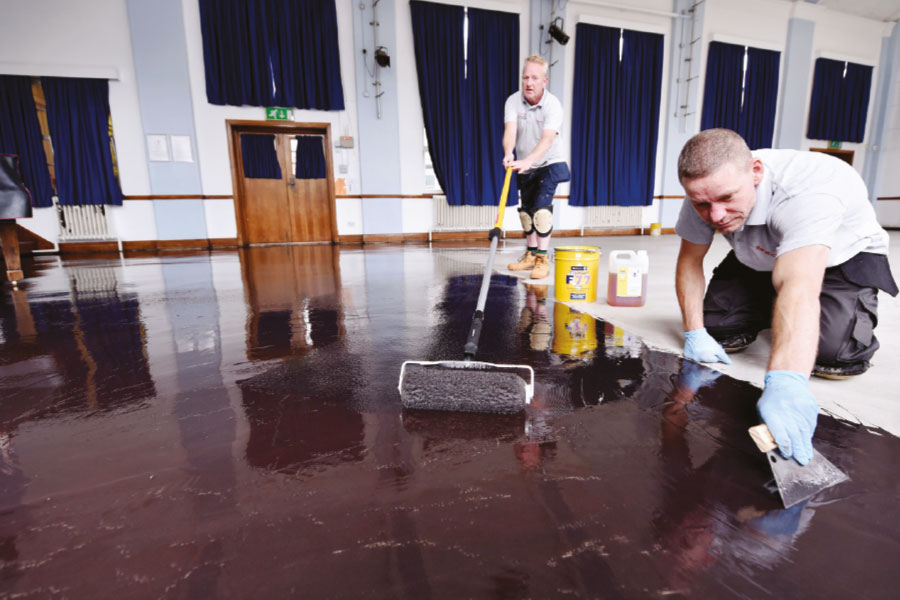
Once a moisture management solution is in place, contractors should prime the subfloor before the application of a smoothing compound to ensure a perfectly smooth base for the receipt of the floorcovering.
F Ball recommends using a heavy-duty smoothing compound, such as its Stopgap 300, prior to the installation of wood floorcoverings because they are better able to withstand the added strain exerted by the natural movement of the wood.
Adhesive selection
Finally, contractors must select a specialist wood adhesive to install wood blocks or planks. Utilising the latest technology, flexible wood floor adhesives provide an elastic but strong bond, which will accommodate natural movement of wood flooring over its lifetime, ensuring a long lasting, visually attractive floor finish.
For example, F Ball’s Styccobond B95 flexible wood floor adhesive provides good initial tack whilst also allowing for repositioning of floorcoverings during the initial stage of drying, an advantage when installing wood blocks.
F Ball also recommends Stycco Flex, its rapid-curing flexible cartridge adhesive, as an alternative for securing header rows. Its rapid strength build-up aids installations where subsequent rows are butted up to the head row using a mallet and a tapping block. Stycco Flex can also be used to install skirting boards and trims.
Taking this systematic approach to wood flooring installations not only optimises their appearance from the outset, but for years to come.
www.f-ball.co.uk
Neil Sanders is technical director at F Ball and Co
Please click to view more articles about
> F Ball <