
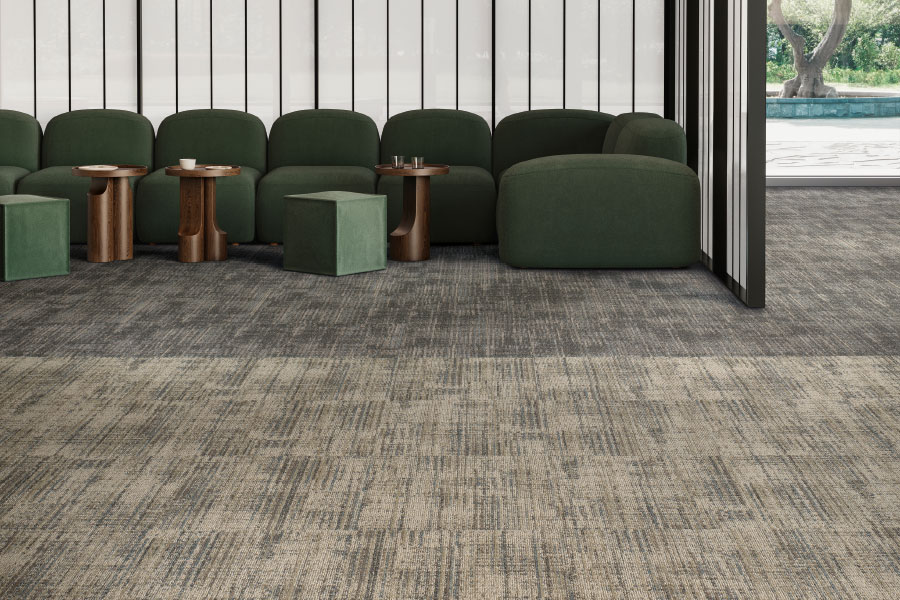

IN an age when resilient flooring and vinyl planks dominate headlines, you might assume carpet tiles have had their day.
Yet according to Andrew Jackson, Business Development Director at Shaw Contract, the opposite is true. Carpet tiles are evolving fast in performance, design, and sustainability, and their transformation reflects a wider shift towards modular flooring as the smart choice for commercial interiors.
‘Modular flooring is now the go-to across commercial sectors,’ says Andrew. ‘We have seen a move away from traditional sheet products, whether in carpet or resilient, because modular formats are so much more adaptable for installation and maintenance. It is quicker to install, easier to replace, and better suited to how modern spaces work.’
At Shaw Contract, that shift has led to a wider rethink of identity. ‘We now define ourselves as a modular flooring supplier, not just a carpet tile manufacturer,’ he explains. ‘It’s a subtle difference but an important one because modular design is driving innovation and growth across the flooring sector.’
Reinventing the carpet tile
Carpet tiles have always been known for their performance in commercial settings. They offer strong fire safety credentials, an aspect that has come under increased scrutiny since Grenfell, and they provide acoustic benefits that hard surfaces simply cannot match.
‘Tiles absorb and reduce noise transmission,’ says Andrew, ‘which is vital in workplaces, schools and healthcare environments. They are also comfortable underfoot, which makes a real difference in high-traffic or collaborative spaces where people are on their feet all day.’
Beyond comfort and safety, sustainability is at the heart of the carpet tile’s revival. ‘Most major manufacturers are leading the way in sustainable materials and circular design,’ he continues. ‘The real breakthrough now is thinking of carpet tiles not as disposable commodities but as assets that can be reused, remanufactured, or recycled.’
Design for disassembly and circular thinking
One of Shaw Contract’s biggest areas of innovation is what Andrew calls design for disassembly. ‘It’s about creating products that can be easily taken up and reused,’ he explains. ‘We promote adhesive-free installation across all our modular products. That means at the end of a product’s life, we can lift it cleanly without damaging the subfloor or raised access floor below. It’s simpler for the client, reduces waste, and saves significant carbon and cost.’
This approach supports Shaw Contract’s Second Location Warranty, a unique promise that allows carpet tiles to be reused in another building. ‘If a client decides to move or refurbish, those tiles do not need to go to landfill,’ says Andrew.
Legislation, takeback and product passports
As governments tighten environmental regulations, Andrew sees takeback schemes and traceability becoming central to flooring manufacture. ‘In the near future, we expect legislation to require manufacturers to take responsibility for end-of-life materials,’ he says. ‘We’re ready for that change through our takeback programme re[TURN], where we operate a closed loop recycling process for our EcoWorx product and for other carpet tiles we give them a second life through our partnership with The Salvation Army Trading Company.’
Linked to this, the idea of digital product passports is gaining ground in the EU. ‘Passports will record every aspect of a product, including materials, location, age, and installation data, so when it reaches end of life, you know exactly what to do with it,’ he explains. ‘It’s a simple concept with huge implications for circularity. Imagine a facilities manager overseeing a school or office estate. They could scan a tile, see that it was installed seven years ago, and instantly arrange for its collection and recycling. That kind of transparency will make sustainability practical, not just aspirational.’
The design advantage
Of course, the appeal of carpet tiles isn’t just technical. Design flexibility remains one of their strongest selling points. ‘You can mix colours, textures and patterns across different price points without losing visual consistency,’ says Andrew. ‘That’s something Shaw Contract does particularly well. We build colour families that carry across collections so designers can combine products freely without compromise.’
This flexibility is being amplified by modular thinking. ‘Modularisation doesn’t mean one size fits all,’ he explains. ‘It’s about freedom. Carpet tiles can define zones, add warmth, and complement and contrast with resilient flooring. As workspaces evolve and hybrid layouts become standard, that adaptability is invaluable.’
Beyond bitumen and towards better materials
Material innovation is another key differentiator. ‘Most of our carpet tiles are now bitumen-free,’ Andrew notes. ‘We’re exploring new backing systems and recycled content that make them lighter, more durable, and easier to handle. Every improvement helps reduce embodied carbon and supports healthier buildings.’
He points to Shaw Contract’s focus on material health and indoor air quality. ‘We talk about the occupant, the person using the space,’ he says. ‘That means ensuring low VOCs and safe, transparent ingredients. Sustainability isn’t just about recycling, it’s also about creating better environments for the people who use them every day.’
Reinforcing the case for carpet tile
While resilient products have grown, Andrew believes carpet tiles continue to hold their ground by offering a complete balance of comfort, acoustics, safety, and design freedom.
‘There has been a perception shift,’ he admits. ‘Some specifiers moved to resilient for practical reasons, but we are now seeing them return to carpet tiles because of their long-term performance and circular potential.’
He sees the next few years as pivotal. ‘Future legislation, digital passports, and the circular economy will all play to carpet tiles’ strengths,’ he says. ‘This is an opportunity for the category to reinvent itself, to prove that it is not just relevant, but essential to the next generation of sustainable interiors.’
Carpet tiles may have been declared dead more than once, but as Andrew Jackson points out, they are not going anywhere. ‘Carpet tile is dead? Long live carpet tile,’ he says. ‘With circularity, modularity and innovation driving change, we are only just getting started.’
0207 961 4120
infouk@shawcontract.com
shawcontract.com/en-gb
33 Great Sutton St, London EC1V 0DX
Manufacturing Plant: Building G, Blackaddie Road, Sanquhar, Scotland DG4 6DB