
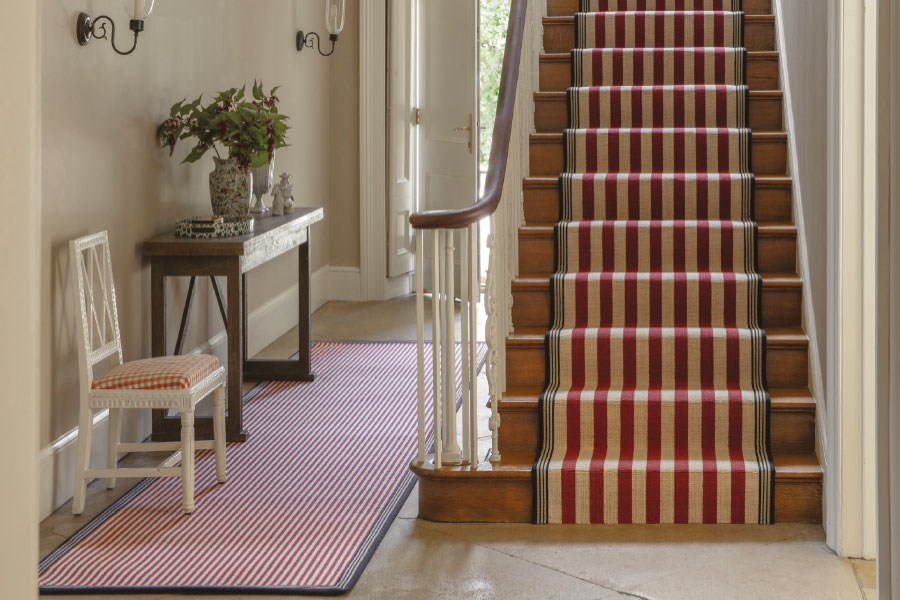

WHEN Alternative Flooring launched more than 30 years ago, it was best known for its natural textures (sisal, seagrass and coir), bringing the warmth and honesty of handwoven fibres into homes and boutique spaces.
Today, under the guidance of sales director Richard Hackett, the company is much more than a purveyor of plant-based carpets. It’s evolved into a design-led interiors brand, blending craft and sustainability with bold use of colour, pattern and innovation.
‘The industry still thinks of us as the sisal and seagrass people,’ says Richard, ‘but we’re far more than that now.’
Alternative Flooring was acquired two years ago by Ulster Carpets but continues to operate independently, a deliberate move that allows the business to retain its creative freedom. ‘Ulster supports us but leaves us to grow,’ says Richard. ‘We’ve been able to build on what makes us distinctive: a focus on craftsmanship, innovation and sustainability, expressed through texture and design.’
The company’s product portfolio is increasingly diverse. From its roots in natural fibres, it now includes carpets made with wool, recycled PET and even fully circular manmade materials designed to be reprocessed at the end of life. This evolution reflects both environmental responsibility and market demand.
‘The younger generation has grown up with synthetics,’ Richard notes. ‘They have their place – modern recycled materials can offer durability and exciting design possibilities – but wool shouldn’t be overlooked. It’s renewable, beautiful, and performs brilliantly. We’re pushing to bring it back into focus as part of a balanced approach that values both natural and innovative circular materials.’
Richard’s vision for Alternative Flooring is to ‘drive what we want to be in terms of shape and profile of the business’. That means moving beyond the limits of traditional manufacturing and questioning how products are made.
The company now works closely with designers to develop considered, cohesive collections that offer breadth of texture and tone, but remain tightly curated. The goal, he explains, is to create collections that tell stories, each range with a purpose, a provenance, and a tactile appeal.
‘We start at the beginning,’ Richard says, ‘looking at our supply chain, at sustainability and craftsmanship. We’re challenging that supply chain, asking what yarns can do differently, and how we can use recycled or renewable materials without compromising design.’
One of the most striking examples of this innovation is Echo-CoRE, a new product the company unveiled at London’s interior design trade show, Decorex. Richard believes it may be the first fully circular domestic carpet on the market. ‘This isn’t greenwashing,’ he says firmly. ‘When we say it’s circular, we mean it, we’ll take it back at the end of its use and ensure it goes back into the system.’
At Decorex, Alternative Flooring will also unveil 10 new ranges spanning recycled PET and new wool designs, each distinguished by colour and texture. It’s a statement that the business is not just responding to sustainability trends but leading them. ‘The contract sector has driven innovation for twenty years,’ Richard explains. ‘Now the domestic market needs to catch up.’
For Richard, sustainability isn’t only about materials. It’s about rethinking the entire model of consumption. ‘You have to get away from landfill,’ he says. ‘If you can recycle it, you close the loop. Wool, for example, biodegrades naturally; put it in the ground and it’s gone in a few months. Yet despite wool’s environmental advantages, its commercial value has suffered. However, wool is still one of the most sustainable materials we have. The industry needs to trace it from farm to floor and rebuild that respect for it.’
Education, Richard believes, is the missing link. ‘We need to educate the new generation that wool is good,’ he says. ‘You can have natural materials that look beautiful, perform well and are sustainable. The challenge is getting that message into the supply chain and into newbuilds. Open-plan, hard-surface living has made carpets less common, but that’s changing. People want warmth, texture and natural comfort again.’
Alternative Flooring’s customer base reflects this shift. The company has never been a high-street brand, it doesn’t sell through the national chains. Instead, it supports independent retailers, contractors and end-user clients through a licensed approach. ‘We’re not in the nationals,’ Richard says. ‘No John Lewis, no Tapi. We only supply independents, that’s part of our ethos. If a consumer wants our material, they can buy it through an independent shop or online, depending on how their retailer licence works. I don’t know anyone else doing it quite like that.’
That selective distribution ensures quality and exclusivity. Premium retailers, for example, gain access to the full product range and enjoy unique environmental storytelling tools.
‘Every time a customer orders a large sample, we plant a tree,’ says Richard. ‘New staff get trees too; it’s about embedding green thinking into what we do. Retailers can even show customers where their trees are planted. It connects design choices back to environmental action.’
The company’s design and marketing teams are small but deeply experienced. ‘It’s about collaboration,’ Richard says. ‘Our marketing and creative director understands the aesthetic, and together we make sure our ranges feel both crafted and contemporary. Colour, pattern and texture define our brand, but they’re always grounded in substance. We want each product to have a story and a conscience.’
Looking ahead, Alternative Flooring plans to deepen its focus on wool. Part of the Decorex launch will highlight new wool collections designed to bring a contemporary energy to the interiors market.
‘We’re reviewing our wool offer,’ Richard confirms. ‘The British wool industry needs more support, and manufacturers have a role to play. Other countries are seen as having higher-quality yarns, but we need to show British wool has value, too.’
The company’s approach blends commercial realism with idealism. Richard acknowledges that circularity and sustainability come with cost implications. ‘Prices will go up,’ he admits. ‘But that’s the direction the whole construction industry is heading. In 20 years, everything, every product, will need to be recyclable. We want to be ready for that.’
From its early days selling sisal to boutique hotels and designers, to its current push into circular manufacturing and sustainable sourcing, Alternative Flooring continues to live up to its name. It offers a genuine alternative, not only in what its products are made of, but in how the company thinks about the business of making them.
‘Craftsmanship, innovation, sustainability, that’s what we stand for,’ says Richard. ‘We’re proud to be different, and to keep finding new ways to make floors that feel good, look good and do good.’
01264 335111
info@alternativeflooring.co.uk
www.alternativeflooring.com