By Mark Atkins, LTP Director
It can be difficult to get customers to invest in a good tile maintenance regime. Having made the initial tile purchase, any add-ons are often seen as just that; an opportunity for the retailer to bump the price up. Thankfully, the functional role and performance benefits of sealers are now better understood but when it comes to cleaning products, the question often arises: can’t you just use a standard household cleaner?
In the case of porcelain and ceramic, opting for a multi-purpose cleaner generally won’t cause too many issues – although grout, being porous, can be damaged by aggressive solutions. Natural stone, on the other hand, is not forgiving. Using a product that’s too acidic or too alkaline will damage the stone surface and strip out any protection – and this applies to seemingly natural solutions as well as ‘heavy duty’ products.
Let’s take cleaning hacks; some of the most popular are homemade mixtures of vinegar, lemon and soda. Vinegar and lemon are both very acidic, while soda has high alkaline levels. Most general tile cleaners fall into the alkaline category and an AI overview today states that they are “safe for most ceramic, porcelain and stone tiles.” With regard to stone, this is incorrect and yet it’s the information that many consumers refer to time and time again.
A case in point
I often use a vein-cut marble project as an example. The case in point was an installation in a high-end London home which cost about £10,000. The housekeeper applied a spray detergent and left it to run down the face of the vein-cut marble within the shower enclosure. The detergent was a general-purpose kitchen and bathroom cleaner, designed to remove limescale and dirt. On a marble-effect porcelain or ceramic surface, this probably wouldn’t have caused too much of an issue. But because the product was highly acidic, contact with the delicate polished marble caused etching and irreversible damage to the whole of the wall surface. In some instances, an attempt could have been made to re-burnish the marble, to polish out the damage, but the amount of water needed and the size of the bathroom ruled this out.
The insurers got involved. It became clear that the marble suppliers didn’t offer any maintenance advice at the point-of-sale and the installers didn’t give any guidance on aftercare. The architects who commissioned the marble didn’t specify a sealer or provide any care advice – and the cleaners couldn’t have been expected to know the difference between a glazed engineered tile and polished marble. If the correct advice had been given at any stage, the issue might have been avoided.
Eco-products and an extra dose
Surprisingly, many eco-products can also cause damage to natural surfaces. Look closely at the label of a leading anti-bacterial all-purpose cleaner and it states that it isn’t suitable for natural stone because it is acid-based. It’s always worth reading the small print.
Another common misconception is that an extra dose of the right product will do an even better job. But this can actually create problems. Using a stronger concentration may mean that a surface needs to be rinsed; if it isn’t, the residue may form a film on the surface, which could make future cleaning more difficult and potentially create a slip hazard.
Why pH-neutral is a strength, not a weakness
Natural stone should always be cleaned with a suitable pH-neutral solution. And, pH-neutral doesn’t mean that a product is weak or ineffective. It just means that it’s fit for purpose. Quality cleaning products, like our own, are also more concentrated than supermarket cleaners, so they generally work out to be better value in the longer run.
Choosing a suitable product is also key, for all types of tile. For example, washing up liquid is generally neutral to slightly alkaline and is branded as being gentle. It appears to be harmless but when water evaporates, it leaves a layer of detergent on the surface of the tile. This tactile layer builds up and creates a key, which attracts dirt, and potentially a slip hazard. Some contract cleaning products which contain waxy ‘maintainers’ for a just-mopped finish can also create similar issues. Professional tile and stone cleaners, used at the correct no-rinse dilution, don’t leave any residue, eliminating these problems.
Avoiding an unhappy ending
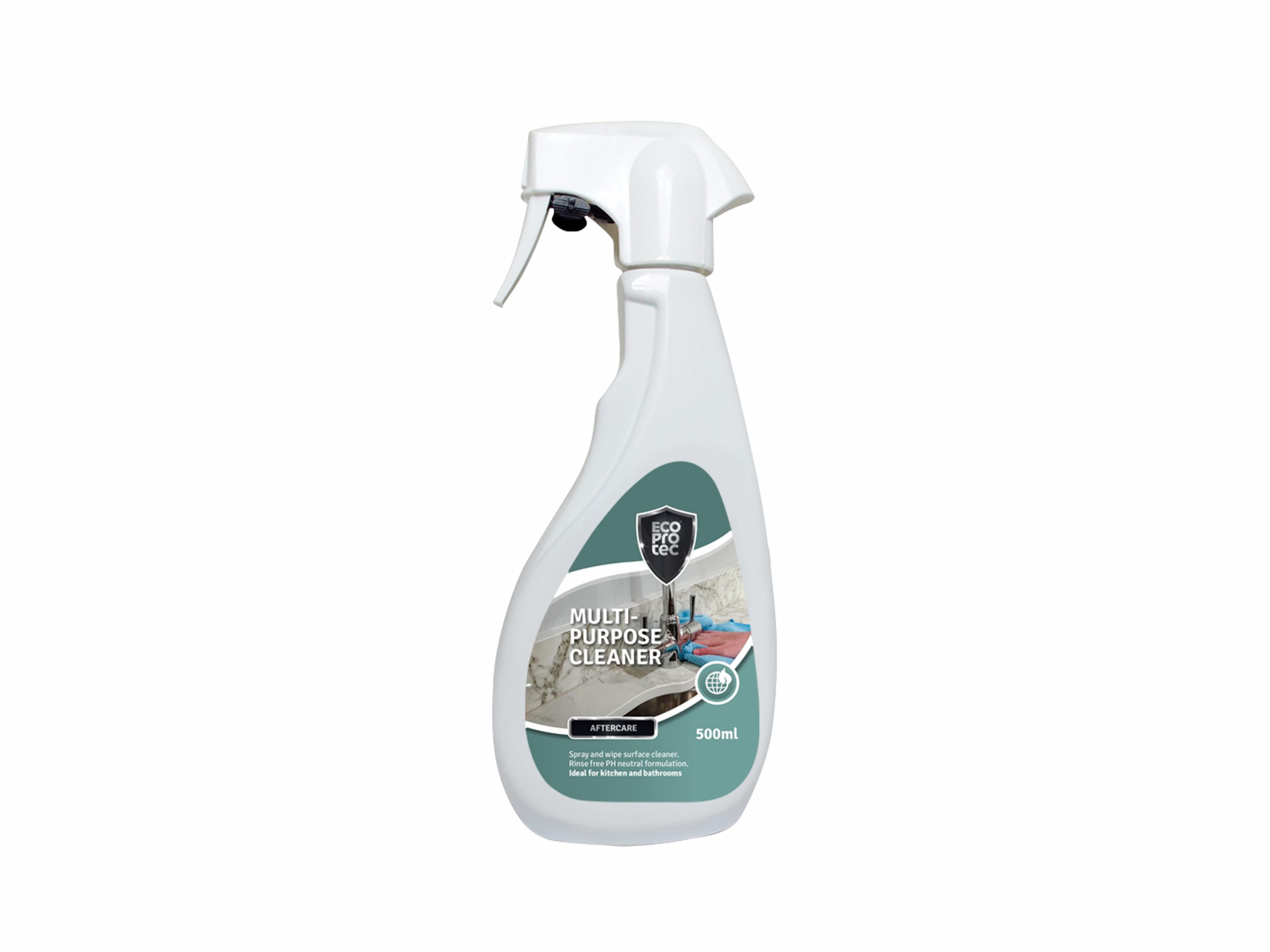
The London case study serves as a good example all these years later; the investment is worth it – and it’s always worth offering that best practice advice, no matter how prickly the customer might be. Shockingly, the cleaning product that caused the damage cost just 64p. A concentrated, specialist neutral detergent, like our own ECOPROTEC Multi-Purpose Cleaner, wouldn’t have cost any more, per wash.
For more advice, browse ECOPROTEC TV on YouTube, contact the ECOPROTEC team direct on 01823 666213 or email technical@ecoprotec.co.uk