

Rapid environmental fluctuations…poor materials…juggling indecisive customer requests…these can be frustrating scenarios for flooring professionals. But nothing is more frustrating than flooring failures due to hidden moisture.
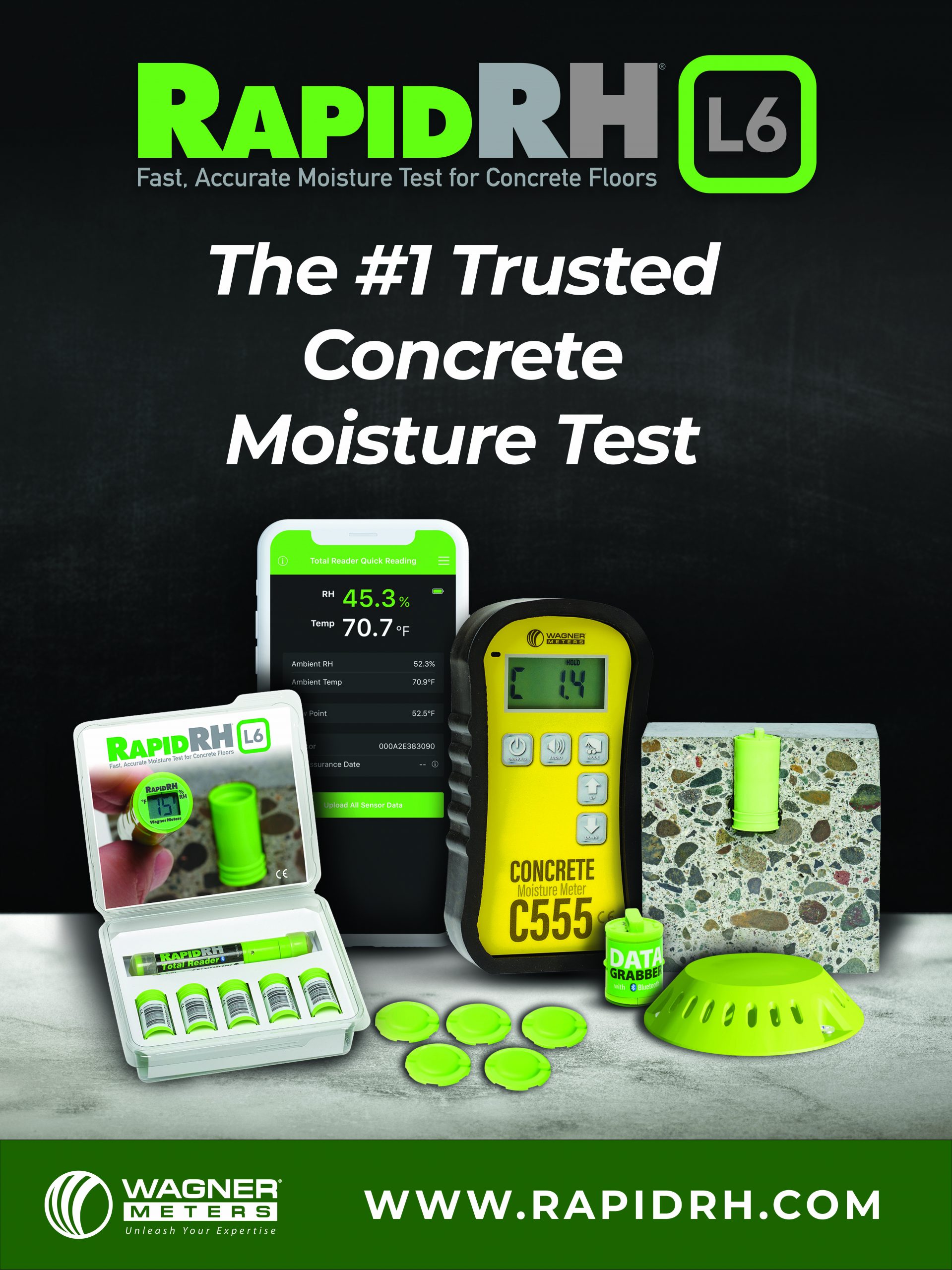
That’s why comprehensive subfloor moisture testing is essential before installing floors on top of concrete or screed. And using Rapid RH along with the C555 concrete moisture meter makes for a highly effective moisture testing combo to ensure the subfloor is ready for a floor covering.
We’ll discuss the whys and hows by looking at:
- Concrete moisture and its impact
- Tools for concrete moisture testing
- Best practices for concrete moisture testing
- Testing for in-floor heating installation
- Using Rapid RH and C555 for complete moisture assessment
Let’s first review concrete moisture and its impact.
Understanding Concrete Moisture and Its Impact
Not monitoring moisture in concrete can be really risky, especially when installing in-floor heating systems.
Concrete naturally releases moisture through the slab’s surface from the time it’s poured until it “dries.” But this process creates a moisture gradient, where the moisture closer to the surface is released faster while the moisture deeper down takes longer to move upward. So the surface of a slab can seem completely dry when there is still excess moisture underneath.
And that excess moisture will keep moving up, even if a floor covering is installed over top. Then that moisture becomes trapped between the slab surface and the flooring, which can cause issues such as:
- adhesive failure
- warping
- bubbles
- discoloration
- mildew or mold
On top of that, heat from an in-floor heating system can further complicate things because it draws even more water from the concrete slab.
But with the right tools, you can responsibly identify and monitor concrete moisture so you don’t install flooring too soon.
Tools for Concrete Moisture Testing
Using Rapid RH in-situ probes, with the help of the C555 moisture meter, you can collect the data you need to determine when a concrete slab has reached the desired equilibrium moisture content (EMC), allowing you to make more confident, informed decisions about installation timing.
Rapid RH in-situ probes
Scientific evidence points to relative humidity (RH) in-situ probes as being the most reliable method for concrete moisture testing.
Strategically placing RH in-situ probes in various locations and at the correct depth within a concrete slab provide the most accurate concrete moisture measurements—not just surface measurements.
Drilling small holes into the concrete and inserting probes at 40% of the slab’s thickness provides ambient condition and RH readings that let you predict how moisture within the slab will act after a floor covering has been installed.
Wagner’s Rapid RH L6 sensors follow ASTM F2170 standards, which many manufacturers require for floor covering installations. When inserted into a slab at the right depth, Rapid RH L6 sensors read relative humidity levels so you can track them and determine when the subfloor is sufficiently dry.
And uploading test results to the DataMaster L6 app makes it easy to keep track of data from all installed sensors.
C555 concrete moisture meter
Wagner’s C555 concrete moisture meter will evaluate moisture up to ½ inch below the concrete’s surface. This will provide the data you need to identify moisture “hot spots” and determine the most effective areas to install Rapid RH in-situ probes. This makes the C555 a valuable tool for optimizing sensor placement and ensuring more precise in situ RH testing results.
You can also use the C555 meter for surface moisture testing if that is approved by the flooring manufacturer.
The C555 is the only concrete moisture meter in the market that allows for in-field calibration. It provides a preliminary evaluation of comparative moisture conditions of concrete, gypsum cement, or other floor slabs and screeds. And it’s twice as accurate as other leading moisture meter brands, according to recent tests.
With the C555 and Rapid RH probes, you simply scan the concrete slab with the C555, detect areas with higher surface moisture readings, and insert in-situ probes in those areas.
The C555 is also a great nondestructive option in situations when this type of measurement is accepted and it comes in handy for areas where drilling is undesirable, such as with in-floor heating installations.
Best Practices for Concrete Moisture Testing
For the most accurate readings, follow these best practices.
Pre-test preparation
- Clean the concrete surface to remove debris and contaminants where moisture meter measurements are to be done.
- Maintain stable temperatures in the environment for ideal moisture testing conditions.
Using Rapid RH for in-depth testing
- Use a hammer drill and masonry drill bit to drill holes at 40% depth in concrete, if drying from one side (20% depth is best if drying from two sides).
- Use a wire brush, vacuum, and attachment to clean out holes.
- Place the needed amount of sensors, targeting areas with the highest surface moisture readings.
- Place at least three sensors for the first 1,000 sq. ft. and one more per additional 1,000 sq. ft.
Using the C555 for surface testing
- Use the C555 on flat surfaces for full sensor contact in smooth areas
- Set up the C555’s alarm to get notified if moisture levels exceed set thresholds, adjustable from 0.0% to 6.9%
- If you’re ever unsure if the C555 is calibrated, use the included calibrator platform to calibrate the C555 back to original factory standards.
Testing for In-floor Heating Installation
Testing moisture for in-floor heating systems takes a bit more care. Flooring installers often avoid drilling into heated subfloors to prevent damaging the embedded heating system. Piercing the electrical cables or heating coils can lead to expensive repairs or even electrical hazards.
Before installing Rapid RH probes, use a thermal camera to locate heating coils and find the best place to drill.
And when appropriate, using the C555 to scan for moisture can be a great, non-invasive alternative in situations when this type of testing by itself is acceptable.
Integrating Rapid RH and C555 for Comprehensive Moisture Assessment
With the C555’s surface moisture readings and the Rapid RH’s deeper readings, you’ll have a more thorough understanding of moisture distribution throughout the depth of the slab.
Let’s say you have a flooring project with a customer and you scan the concrete subfloor with the C555 to identify potential moisture issues. There are some higher moisture readings near one of the walls so, you need more comprehensive data before installation.
You install Rapid RH smart sensors at 40% depth throughout the slab and let the sensors equilibrate for 24 hours.
Once equilibrated, most of the RH readings are under the required 75% (or whatever the floor covering manufacturer specifies), but they’re showing higher readings near the wall, which is above the flooring manufacturer requirements (and will likely invalidate the warranty for not meeting required pre-installation conditions).
But because you used the right tools at the right time, you prevented a future flooring failure.
So as you prepare for each new flooring project, remember to always adhere to ASTM testing standards and flooring manufacturer guidelines to avoid flooring failures. And take extra care when dealing with in-floor heating system.
Visit Wagner Meters for the best moisture testing tools on the market.