
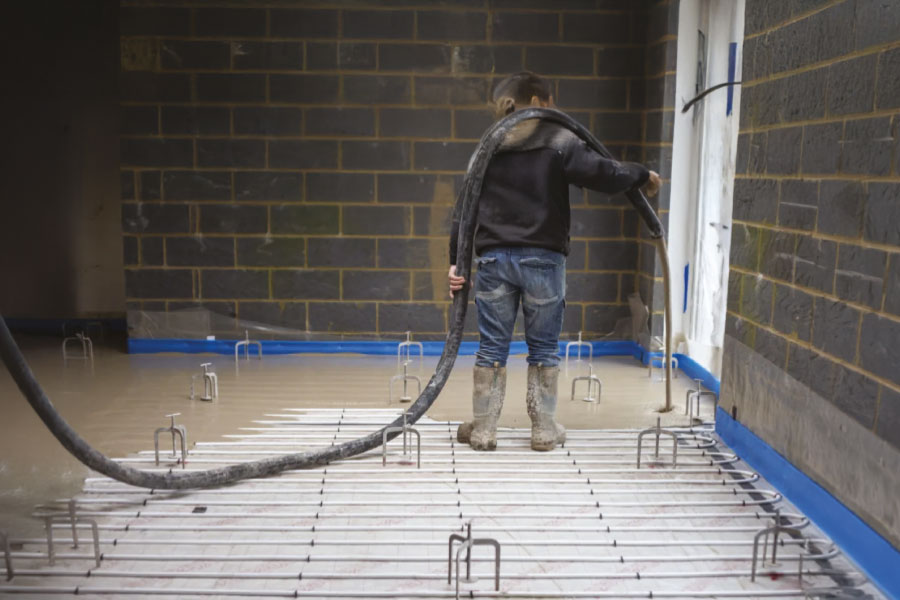

Selecting the right screed can save time, reduce costs, and improve sustainability in construction says BEN BLAND
BETWEEN April 2025 and June 2025 only 7,000 housing applications were granted planning permission, which is the lowest three-month figure since 1979. This process is only likely to become more strained; a recent report from the Royal Town Planning Institute shows two-thirds of public planning teams already lack the capacity to meet demand and 20% of planners say they intend to leave the profession by 2028.
Given these longer timelines, developers, architects and contractors will be looking for ways to speed up the project process.
One area with room for improvement is flooring, which is often overlooked, but provides an opportunity to achieve significant cost savings, as well as design improvements and a reduced environmental impact.
No patience for laitance
The screeding stage is an essential part of the floor-laying process in commercial and residential projects, and traditionally, this will be a sand and cement-based version. Some screeds available on the market generate laitance, which is a build-up of fine particles on the surface of fresh screed that has a milky appearance.
It’s caused by an upward movement of water and causes the surface to be fragile, so it is important to be removed, or it can cause issues with drying and adhesion.
Architects and their contractor partners don’t need to stick to the same screed they’ve always chosen, which often lack qualities to suit their needs. For example, there are anhydrite-based screeds formulated from a by-product called calcium sulphate that don’t produce any laitance after they are poured, thereby removing the stage of sanding laitance and subsequently cutting costs by 66% compared to other anhydrite-based screeds, according to findings from LKAB Minerals’ pilot tests. Although it is important screeds are still sanded to create a bond with the final floor finish. However, that still leaves overall savings, which can be especially significant for an office block or apartment building where there is a lot of floor space to factor in.
Flaw-free floors
When it comes to floor space, JPMorgan’s proposed 3 million-square-feet-plus office in Canary Wharf would take the lead and is more than double the floor space of London’s Shard tower. The potential saving from a laitance-free screed across such an expansive area would inevitably be substantial, but it also raises another important early-stage consideration for flooring.
Different screeds can impact design because of their aspect ratio; those with a greater aspect ratio mean fewer joints are needed to prevent the screed from cracking. Therefore, architects who opt for the screeds with greater aspect ratios will have the option to build bigger bays and benefit from a design boost that comes with expansive unobstructed floor space.
Those design and efficiency considerations should be fundamental, but construction projects aren’t all about looks and money. Research released this summer by the Property Research Trust shows developers increasingly going above and beyond the basic environmental requirements through voluntary commitments such as BREEAM.
Selecting a sustainable screed
It is difficult for project stakeholders to reduce their environmental impact for floor screeds on the market that are cementitious, and the cement production process contributes to 8% of global CO2 emissions. The alternative anhydrite-based versions can carry 88% fewer carbon emissions than cementitious versions, helping project stakeholders meet their environmental commitments.
Those obligations are becoming more stringent in the UK, with the Future Homes Standard mandating that new residential buildings must produce 75% fewer carbon emissions buildings constructed under the previous set of regulations. To support with the transition to lower-carbon homes, underfloor heating systems are increasingly preferred because these can run at lower temperatures than conventional radiators without reducing warmth for occupants. In these scenarios, it is important that project stakeholders choose a screed that has high thermal conductivity so those efficiency gains aren’t lost, which would undermine the sustainability benefits of underfloor heating while driving up energy bills for the occupants.
In addition to conductivity properties of the screed, project stakeholders should look for options that can be poured thinly without any compromise to performance. For example, a screed that can be laid at 35 millimetres instead of 75 millimetres means the occupants will be saved from paying to heat 40 millimetres of flooring unnecessarily. That could equate to around £450 a year of savings from the typical household energy bill in the UK, according to LKAB Minerals’ tests for an innovative type of anhydrite-based screed.
Floors fit for the future
The construction industry is under pressure from planning restrictions, while being expected to deliver high quality projects cost effectively, quickly, and in a way that is sustainable. Navigating those issues is often a complex challenge. But, when it comes to flooring, a simple decision to select the right screed brings a range of efficiency, design and environmental advantages that brings about outsized benefits.
www.lkabminerals.com
Ben Bland is commercial manager at LKAB Minerals