FLOORING IN EDUCATION
EARLIER this year, the Department for Education released a new construction framework for schools being built or refurbished in the next six to eight years. The new regulations affect how architects and main contractors design and build and what products they can specify.
As a flooring professional, it will help you to know what type of sport and multi-purpose flooring is required for each situation, and how helping specifiers select the right one can also help them meet the new environmental limits and targets for the whole building.
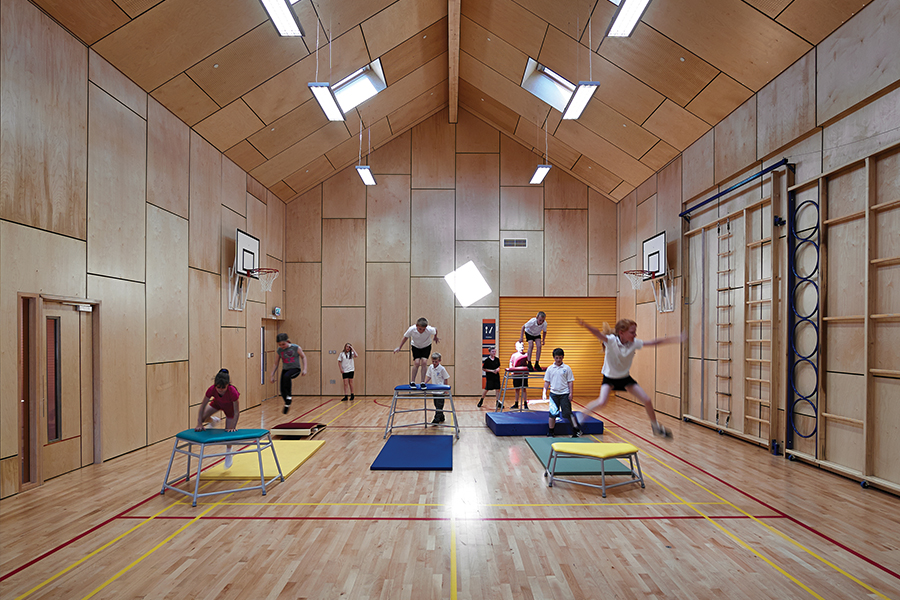
A few years ago, the DfE made area elastic flooring according to the European standard BS EN 14904:2006 compulsory in all school and educational buildings’ sports and multi-activity halls. They offer the best in terms of safety, longevity, performance and cost for all types of sports, PE, dance, performance and multi-use. There are several new requirements that affect sports and multi-purpose flooring selection and installation.
ONE – embodied carbon limit
The first is the introduction of a maximum limit for embodied carbon. As a flooring contractor, you might wonder how this will impact your work – what is it and why does it matter? Embodied carbon is the energy consumed to extract, refine, process, transport and fabricate a material, product or building. Embodied carbon and operational carbon, the energy used to run a building, make up whole life carbon.
Architects and designers started by significantly reduced the energy consumption of a building, which has a direct impact on the building’s environmental impact. In the past few years, those working at the forefront of sustainable design and build have identified that when you reduce energy usage, the embodied carbon in a building can represent as much as 40-70% of a building’s whole life carbon footprint.
This means reducing the embodied carbon is a very effective way to reduce a building’s whole life carbon footprint – the reason why government bodies and other organisations are working hard to reduce embodied carbon.
Specific to school buildings, the UK is taking steps to move closer to a net zero built environment by setting an embodied carbon limit of 550kg/CO2e/sq m for new and refurbished schools. Awarded contracts are dependent on meeting this embodied carbon limit.
To meet the new limit, designers and main contractors need to select materials that are low in carbon, and one of the best options to meet the new requirements is wood.
The difference in environmental terms is quite staggering – if you install a Junckers 22mm solid beech sports floor in a typical 690sq m four-court school sports hall it will contribute a carbon reduction of -9,660kg CO2e. If the same size hall is fitted with a vinyl floor, +9,246 kg CO2e would have been released into the atmosphere. It is a persuasive argument for using solid wood – and if you have some basic knowledge of embodied carbon figures and how they impact a building’s carbon footprint, you will be able to advise the client, the main contractor and the architect.
TWO – biogenic carbon target
Another key measure introduced by the DfE is a requirement to measure the biogenic carbon content of the building. Biogenic carbon is carbon stored in biological materials. Plants, which of course includes trees, absorb CO2 during growth through photosynthesis. When incorporated into buildings, that carbon is stored and locked away from the atmosphere. By way of comparison, the carbon released from products made from fossil fuels is called non-biogenic carbon.
Combustion of products made from oil-based plastics generates significant carbon emissions and increases global warming. This is why the DfE and other organisations are seeking to include more materials that contain biogenic carbon, such as wood.
The DfE CF 25 Technical Manual outlines that designs should use natural materials to create a healthy learning environment, targeting biogenic carbon of – 20kg CO2e/m2 from sequestration (carbon capture) for the whole building.
Again, this may sound a tad scientific, but when you understand how significant a contribution a wooden floor can make to the environmental impact of the whole building, and how by selecting a wooden floor will help meet the new target for school buildings.
Contractors vying for contracts must demonstrate how they’ll achieve a reduction of -20kg CO2e/sq m for the whole building. Installing a solid hardwood floor from Junckers in a 690sq m four-court sports hall will contribute a figure of -18,699kg CO2e to offset the total figure for the whole building, says the company.
Needless to say, by installing more wood elsewhere in the school, the figure will be even higher.
THREE – Floors used with FF&E
The final new regulation for the type of floor used with FF&E, furniture, fixtures and equipment. For any schools built or refurbished under the new construction framework, floors for multipurpose halls, sports halls and activity studios where FF&E is used within the space must be timber floors.
This includes retractable seating, desks and chairs for when the hall is used for exams, dining furniture, as well as machinery. The type of timber allowed is maple, beech or oak; solid hardwood or engineered wood with a minimum hardwood veneered surface of 6mm.
Vinyl floors are only allowed for use in dedicated dance and activity studios
with no FF&E use.
Familiarising yourself with the new regulations will help you quote for jobs with confidence. You may even find yourself in a position to be able to provide help and advice – these limits, targets and requirements are new to everyone.
01376 534700
sales@junckers.co.uk
www.junckers.co.uk