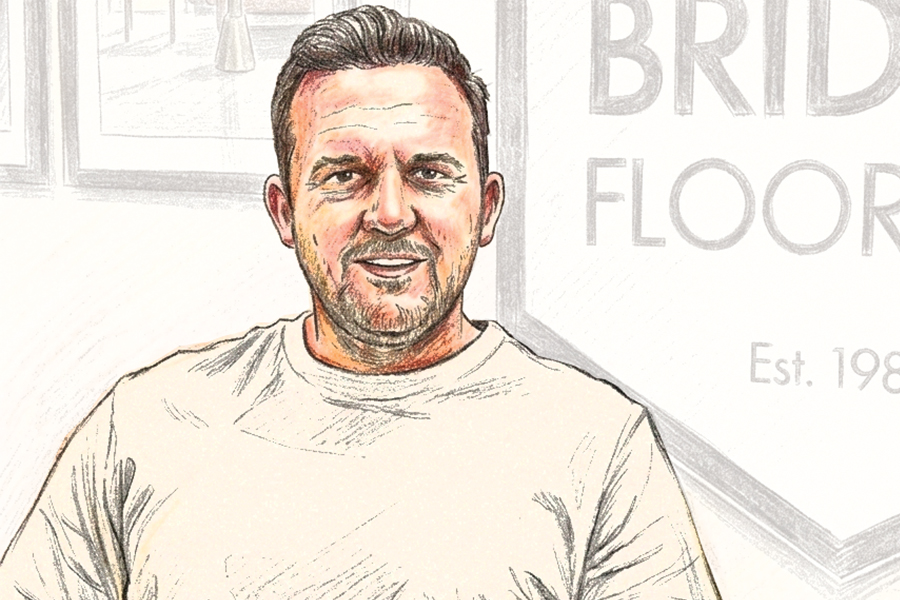
Tommee O’Hara
When David Flindall retired to Spain, he began teaching his UK-based stepson how to run Bridge Flooring the only way he could – one phone call at a time, writes David Strydom
TOMMEE O’HARA tells me his career in flooring began at his stepfather David Flindall’s contract flooring business. Technically, though, it began with a motorbike.
At 14, Tommee landed a work experience placement at Woodford Motorcycles – his next-door neighbour’s shop – and what he believed was hands-on mechanical experience. ‘I thought I was doing MOTs,’ he says with a grin, ‘but I was probably just cleaning alongside the engineer.’
The placement became a weekend job, the weekend job became a fixture and Tommee learned his first lesson in the world of work: show up, keep your head down and make yourself useful.
Today he’s managing director of Bridge Flooring in Woodford Green – the same business he joined as a teenager, working alongside his stepdad on the tools, getting dropped off at jobs because he was too young to drive.
The early years were hands-on in every sense. Tommee spent four years on the tools, learning the trade from the ground up: floor sanding, restoration work, the physical graft that gives you an understanding of a job no office ever could.
‘Clients probably thought: who is this young kid sitting in my house?’ He pauses. ‘But I think I was pretty good with it, really.’
LVT, he admits, was a different story. ‘I was a bit clumsy. I didn’t get on too well with it.’ So he moved inside, to estimating, into the showroom, serving customers, working seven days a week between the ages of 19 and 22.
When his stepdad decided to retire, Tommee, then 22, was the natural successor. He’d already moved out of home at 18, taken on a mortgage and begun investing in a property portfolio. ‘My stepdad told me not to limit myself in terms of what I could achieve, especially early on,’ says Tommee. ‘That was probably the best advice I’ve ever received. I was 18, earning about £200 a week, and I took on a mortgage at the same time. Everything I earned went straight into that. It was tight, but as my income grew, it gave me more freedom and I could start to build properly.’
He adds: ‘I was always driven to earn and invest’ – although such financial seriousness sits oddly alongside his memory of spending his first paycheck on a bag of sweets. Or possibly a PlayStation game. ‘Probably both,’ he laughs.
When his stepdad floated the idea of handing over the business, it wasn’t a dramatic moment. One thing led to another, as Tommee puts it. But the handover itself was handled with real care.
His stepdad and mum relocated to Spain, and at first the phone never stopped. ‘We spoke everyday – problems, questions, measures. I’d send him something to work out and he’d show me how he’d do it.’
Slowly, though, the calls became less frequent. Then less frequent still. ‘The amount we spoke just wilted down,’ Tommee says, ‘and then I was left on my own accord.’ He was on his own.
Born on 4 April 1990 at Whipps Cross University Hospital in Leytonstone, East London, Tommee is now in the driver’s seat of a successful contract flooring business. Under his management it has become a growing contractor delivering larger-scale commercial projects alongside its established high street retail offering.
The transformation has been driven by a deliberate push into commercial work supported by a warehouse, logistics operation and subcontractor network.
Tommee loves that the industry is ‘so different – no day is ever the same. I find it quite hard to focus on one thing and stay channelled for a long period of time, so the flooring industry really suits me. Every day comes with new challenges, difficulties and achievements, which is all quite exciting’.
There are irritations, of course, the main one shared by countless other contractors. ‘I don’t like being a finishing trade. There’s too much expectation for us to work around others. Some have a lack of care for the product we’re putting on the floor.’
Tommee says one area in which he’d like to see significant improvement is the industry’s approach to landfill and recycling, which he believes is still lagging behind wider environmental expectations.
‘It’s poor how far behind this industry is in terms of what happens to the products we use at end-of-life. There are very limited recycling routes, and I just can’t get my head around that given what’s happening in the world. It’s a fast-moving, large industry, yet we’re still struggling in this area.’
He points to the limited and inconsistent reuse pathways for materials such as carpet waste. ‘At one point recycled carpet was going into equestrian products, then that stopped and it’s now used for insulation. There must be more we can do with these materials than what’s currently available. The potential for proper recycling just isn’t being fully realised.’
Tommee starts most days at a boxing gym in Ongar, followed by a swim or sauna at David Lloyd. There’s something fitting about that – boxing, after all, is a sport that teaches you to stay on your feet when things get uncomfortable, to keep moving, to trust what you’ve learned in training when you’re finally alone in the ring.
It’s not a bad metaphor for how he came to run Bridge Flooring. The calls from Spain drained away, the measures stopped coming back with annotations, and one day Tommee realised that the business, like the man, was standing on its own two feet.