RUBBER AND LINOLEUM
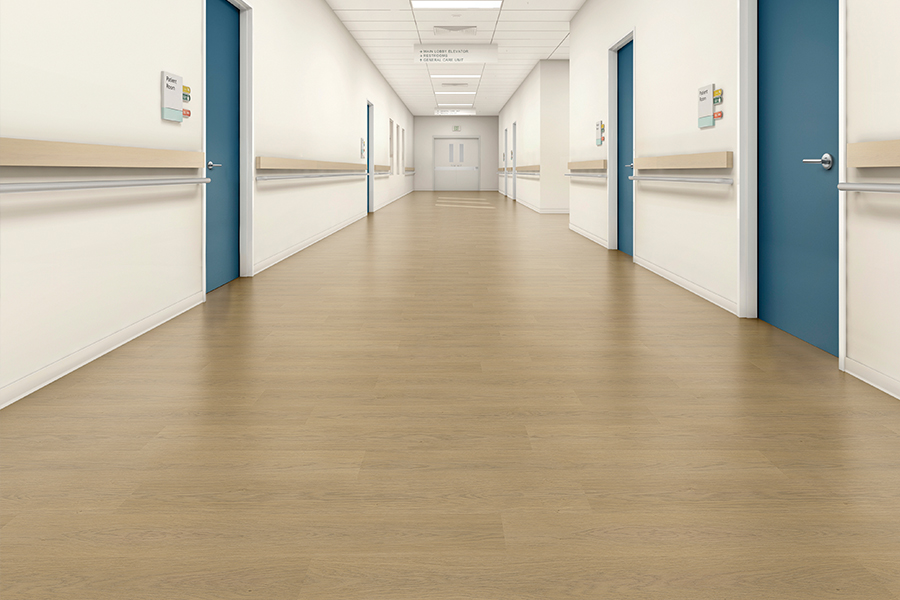
FLOORING in today’s healthcare, education, commercial and public buildings has a crucial yet demanding role to play. It needs to withstand heavy footfall, rolling loads and daily wear, while remaining easy to maintain while maintaining its clean aesthetics for years to come.
In healthcare settings particularly, ease of cleaning and hygiene are key considerations, making rubber flooring a popular choice thanks to its durable, non-porous surface and low maintenance requirements.
However, delivering those benefits relies on more than simply selecting the right flooring product. Installation quality plays a critical role in ensuring the floor performs as intended throughout its lifespan.
Getting the installation right first time not only helps protect the appearance and performance of the floor but can also reduce the risk of costly remedial works, project delays and unnecessary labour costs further down the line.
That’s one reason why products such as Interface’s nora rubber flooring offering is increasingly being specified across a wide range of projects where long-term performance and whole-life value are important, says the company.
But what are the common pitfalls during installation, and how can you avoid them?
Starting with the subfloor
Ask any experienced flooring contractor and they’ll tell you the same thing: most installation issues can be traced back to insufficient subfloor preparation.
Rubber flooring demands a clean, smooth and dry substrate. Cracks, holes and damaged areas should be repaired before any levelling work takes place, otherwise imperfections can show through the finished floor and affect the final appearance.
Moisture is another issue that should never be overlooked.
A subfloor might appear dry on the surface but still contain enough moisture to cause problems further down the line. If moisture levels exceed the manufacturer’s recommendations, flooring can become prone to bubbling and debonding.
Taking the time to test the subfloor properly and, where necessary, install an appropriate damp-proof membrane can save significant time and expense later.
While moisture testing may seem like an additional step in the project, the cost is minimal compared to the disruption and expense associated with replacing a failed floor after handover.
Adhesion, adhesion, adhesion
Once the floor is properly prepared, attention turns to the adhesive system.
Selecting the right adhesive system isn’t simply a case of choosing a product that will stick flooring to the floor foundation.
It needs to be suitable for the environment, the expected foot traffic and the demands of the building throughout its lifespan. Using the correct adhesive from the outset can help avoid premature failures, reducing the likelihood of call-backs, repairs and associated costs.
An obvious but just as important step, the subfloor should be thoroughly vacuumed before installation begins. Even small amounts of dust or debris can interfere with the bond and compromise the finished result.
Many installers also find it beneficial to dry-lay the material first, giving it time to acclimatise to site conditions before fixing. It’s a simple step, but one that can help prevent unnecessary stress in the material and make achieving a clean, professional finish much easier.
For sheet rubber flooring, attention to detail around seams is equally important. Careful cutting, correct overlaps and accurate double-cutting all contribute to a tighter fit and a better-looking installation.
Use the support that’s available
One of the biggest advantages contractors have today is access to detailed installation guidance direct from manufacturers.
Manufacturers such as Interface provide comprehensive guidance covering everything from subfloor preparation and acclimatisation through to adhesive selection and installation techniques for its full nora rubber offering.
Referring to them early in a project can help avoid common mistakes and provide reassurance that the installation is being carried out in line with best practice.
Communication is key
A common challenge on many projects isn’t the flooring itself; it’s the project timings. Flooring installation is often one of the final trades on-site, meaning contractors can face pressure to work around delays elsewhere.
Unfortunately, rushing preparation work or installing before site conditions are suitable is where problems often occur. Open communication between flooring contractors, main contractors and manufacturers can help identify potential issues early and ensure installation quality isn’t sacrificed to meet unrealistic deadlines.
Ultimately, successful rubber flooring installations come down to getting the basics right. Thorough preparation, the correct adhesive, attention to detail during installation and making use of manufacturer guidance all play a part.
While these steps may add time to the planning and installation process, they’re a relatively small investment when compared with the cost of remedial work, material replacement, and disruption to building users. In environments such as healthcare, education and commercial workplaces, where downtime can have significant operational implications, getting the installation right first time delivers benefits for both contractors and end-users.
When those elements come together, solutions such as noravant timber can deliver the durability, appearance and whole-life value that clients increasingly expect from modern flooring specifications, says the company.
www.interface.com/GB/en-GB